
Showing posts with label buses. Show all posts
Showing posts with label buses. Show all posts
Wednesday, September 19, 2012
Fair fares
Saturday, June 23, 2012
Tackling transport
 Copy of my comment on this story, trying to bring Bristol City
Council Cabinet Member and Cllr Gary Hopkins (pictured) back reality through proper
transport performance indicators for our city:
Copy of my comment on this story, trying to bring Bristol City
Council Cabinet Member and Cllr Gary Hopkins (pictured) back reality through proper
transport performance indicators for our city: @ gary_hopkins - can I remind you that we need to see positive transport outcomes in Bristol eg traffic reduction, significantly lower congestion and delay, much lower air pollution, carbon emissions falling in line with what best science says is needed and in line with the Climate Change Act...We simply aren't seeing significant improvements in the major performance indicators. I also remind you that part of the current transport plans includes building new roads - hardly likely to produce the transport outcomes I've indicated. If you have solid evidence to the contrary then I'd like to hear it.
Cllr Hopkins reply simply made no comments at
all about traffic reduction - and no comments at all about carbon emissions. On
congestion he said, rather lamely, ‘...conjestion [his spelling] and delays are
down but not by as much as they should be because the dividends of these are
for the time being being swallowed by First instead of being passed on to
customers.’ This appears not to be about overall congestion and delays but in any case admits there is no significant reduction.
On air pollution he admits there is still a problem but that the European
green capital assessment rates Bristol as best (!!!). In his words, ‘Air
pollution is still a problem but it was interesting that the technical
assesment for European green capital rated us best of any entrant on that area.
The BRT will run on non fossil fuel and will make a significant contribution.’
Green capital assessment rates Bristol’s air pollution as best! This
only goes to show how low their standards are. No evidence in his comment to
back the claim that BRT will make a 'significant contribution'. It’s mere
assertion therefore.
Cllr Hopkin’s denied it was mere assertion and gave some additional
waffle and opinion but did not actually give any data or reference to data to
back his assertions. It’s note-able that he simply did not comment at all on
traffic reduction and on carbon emissions from transport which I specified
along with air pollution and congestion as performance indicators. What
forecasting/modelling has been done that shows that current transport plans
will produce significant reductions in these? Does Cllr
Hopkins have this data??
What Cllr Hopkins seems unwilling to recognise and acknowledge is that
key transport outcomes such as overall traffic flow, air pollution, congestion
and delay and carbon emissions are very unlikely to significantly improve under
current transport plans such as GBBN and BRT with its associated road building.
In fact some of them may well get worse. An RAC Foundation report in 2011 said there will be four million more cars will
be on the roads in the next 25 years. It goes on to forecast a 43% rise in
traffic volume by 2035. Department for Transport figures show that by 2035
traffic will rise by nearly 50% and delays more than 50%on average (more here). To make
real and lasting improvements realities have first to be acknowledged. Some useful information on transport in Bristol here.
Friday, June 15, 2012
Bendy buses
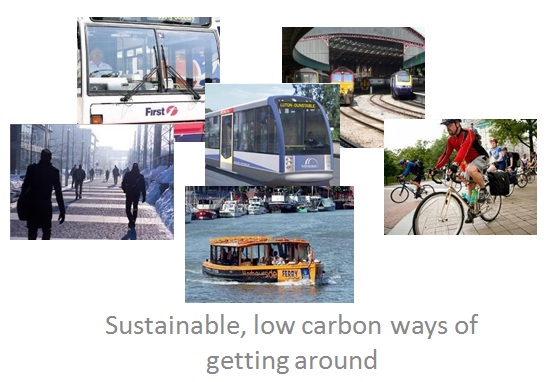 I'm an opponent of the current Bus Rapid Transit plans but
as a keen advocate of communal, public transport I'd like to see investment in
BOTH the Bristol bus and rail system (in addition to walking and cycling) and
in combining all of these smoothly (see story and comments here).
I'm an opponent of the current Bus Rapid Transit plans but
as a keen advocate of communal, public transport I'd like to see investment in
BOTH the Bristol bus and rail system (in addition to walking and cycling) and
in combining all of these smoothly (see story and comments here).Light rail is just about the most energy efficient form of motorised transport and it is likely to be more successful in getting car drivers to switch modes. However, it should not be a matter of rail vs bus, though I acknowledge that there is only so much money being made available.
FOSBR are right to oppose BRT, not least because of unsuitable routes and new roads, but I'm not so sure about all their reasoning. The case I'd make against bendy buses is that they have potential problems with: insufficient effective motive power; slower speed and acceleration due to the extra weight; overheating leading to stalling, or even a fire if diesel fuelled; in crowded areas with narrow streets and tight turns the accident rate may exceed than conventional buses. Bendy buses are supposed to be highly fuel efficient but this must be dependent on the city and the system they are running on and so in practice I have doubts that they will be more efficient in operation than double deckers here in Bristol. Mind you some parts of FOSBRs rail alternative are non-starters - a tunnel under St Mary Redcliffe is both impractical and likely to be far too costly.
There is a problem with money availability if we are to
invest in both buses and rail. Yet we need to invest several times what is
available for BRT if we are to make a serious dent in Bristol’s traffic and
traffic-related problems. It will be interesting to see how the Mayor elected
in November approaches this. There is a problem with our congested roads
because we need to make the existing bus system more effective and efficient
and extensive, if we are genuinely trying to meet targets such as absolute
traffic reduction and significant lowering of pollution - so are we willing to
make a decent number of existing roads car and lorry free?? And would a Mayor
be willing to bite this bullet?
More thoughts on sustainable transport here:
More thoughts on sustainable transport here:
Tuesday, May 15, 2012
Stop BRT2
 Passing on details of this site and campaign. I'm preparing some emails to send to the relevant cabinet members and councillors asking questions and opposing the scheme.
We want BRT2 stopped because
It will not achieve its primary goal of addressing Bristol's transport problems and needs.
It will not achieve its goal because it is a flawed plan, badly designed, too expensive, and will have adverse effects on the city, the environment, and local people.
It will not achieve its goal because it is a flawed plan, badly designed, too expensive, and will have adverse effects on the city, the environment, and local people.
STOP BRT2 | . . . there are better ways
Labels:
BRT2,
bus rapid transit,
buses,
design,
economics,
environment,
needs,
people,
planning,
public transport


Wednesday, December 21, 2011
Sustainable suggestions
‘Creative’ and ‘exciting’ ideas sought for derelict depot land Bristol Temple Meads station. Er...its right next to Temple Meads so doesn't that strongly suggest a sustainable transport development of some kind and/or something that large numbers of people would need to get to...like an arena? Also next to a river with big water movements, which suggests a renewable energy facility...
Labels:
arena,
buses,
cycling,
energy,
light rail,
public transport,
renewables,
sustainability,
sustainable,
trains
Monday, August 22, 2011
Opposing the 'South Bristol Link' (ring road)
 Passing on details of this group and campaign (campaign postcards are now available I think): For the past five years, Transport for Greater Bristol Alliance has opposed the West of England Partnership's proposal to build a new road through South Bristol and its greenbelt. A previous application to build a road by North Somerset was turned down by the Government in 2002 as 'poor value for money'. As originally proposed in 2006, the road was seen as completion of the Ring Road, a dual carriageway running between Long Ashton through South Bristol to link up with the existing Ring Road at Hicks Gate. The Council decided to drop Stage 3 (Hartcliffe to Hicks Gate) due to strong local opposition. The road was renamed the 'South Bristol Link' and a Bus Rapid Transit has been added. The SBL is now being sold as an essential part of a wider BRT network. We continue to oppose the current scheme.
On 9th Sept 2011, the Partnership (four local councils) is applying for funding to the Department for Transport (DfT) for this £45m scheme along with BRT2 (Long Ashton P and R to Cabot Circus) and BRT3 (Northern fringe to Hengrove). TfGB has produced postcards addressed to Norman Baker, Under-Secretary of State for Transport for members of the public to use to object to SBL (deadline 7th October). You can get postcards and further information from pip_sheard@hotmail.co.uk. On the campaigns page is a four page briefing outlining details of the current scheme and why we believe the combined road and Bus Rapid Transit is poor public transport value for money and environmentally damaging and should be rejected by the DfT.
Transport for Greater Bristol
Monday, July 25, 2011
BRT = Build Ring-road Tomorrow
Millions of pounds on what is supposed to be an integrated, 'seamless' approach to public transport - and the bendy buses wont even stop at Temple Meads! No joined up thinking there then.
BRISTOL City Council's flagship Ashton Vale to Temple Meads bendy bus route will not actually stop at the station, it has emerged.
The £50 million scheme is one of three rapid transit routes the council is finalising, ahead of submitting funding bids to government in September.
The idea is that the three routes will make life much easier for people who want to get from one end of the city to another.
It is also supposed to be part of an integrated approach to transport, so buses, rail and rapid transit all work seamlessly together.
The problem is that the latest version of the Ashton Vale to Temple Meads route doesn't stop at Temple Meads because there isn't enough money to pay for a stop there.
That means people arriving into Bristol by train won't just be able to just jump on the bendy bus or vice versa.
Instead the stop for the Temple Meads area is actually outside the KPMG building in Temple Street, the other side of the Temple Circus roundabout.
So anyone who wants to get from the bendy bus to catch a train has at least a five-minute walk across one of the busiest roundabouts in Bristol and several sets of traffic lights...
http://www.thisisbristol.co.uk/New-bendy-buses-stop-Bristol-Temple-Meads-station/story-13003610-detail/story.html
I'm not a fan of bus rapid transit Bristol-style - especially as it involves new road building. The Lib Dem Cabinet member in charge, Cllr Kent, says "They will cut congestion, reduce CO2 emissions into the atmosphere" There is no evidence for this. I persistently asked questions at public meetings about modelling and projections that had been done and the 'answers' given to me were totally inadequate. Where was the early, timely, high quality information when it was being asked for?? Increasing the capacity of the road network has on all past occasions increased total carbon emissions as the space fills with traffic and becomes congested and this 'link' - as their spin is now calling it - will do likewise.
Cllr Kent has also referred to 'massive public transport improvements'. Massive? No - and certainly not matching the scale of Bristol's transport problems. Improvements? Evidence of this is seriously lacking. Developments like a transport hub at Temple Meads and an integrated transport authority would begin to bring significant improvements - but these dont appear to be on the table at all due to political failures over decades.
Cllr Kent and Libe Dem colleagues seem to have forgotten that its hardly green to build over green space that is finite in supply, with its consequent loss of biodiversity, aesthetic and health benefits - and of course the greenery is no longer there to soak up carbon dioxide emissions.
BRISTOL City Council's flagship Ashton Vale to Temple Meads bendy bus route will not actually stop at the station, it has emerged.
The £50 million scheme is one of three rapid transit routes the council is finalising, ahead of submitting funding bids to government in September.
The idea is that the three routes will make life much easier for people who want to get from one end of the city to another.
It is also supposed to be part of an integrated approach to transport, so buses, rail and rapid transit all work seamlessly together.
The problem is that the latest version of the Ashton Vale to Temple Meads route doesn't stop at Temple Meads because there isn't enough money to pay for a stop there.
That means people arriving into Bristol by train won't just be able to just jump on the bendy bus or vice versa.
Instead the stop for the Temple Meads area is actually outside the KPMG building in Temple Street, the other side of the Temple Circus roundabout.
So anyone who wants to get from the bendy bus to catch a train has at least a five-minute walk across one of the busiest roundabouts in Bristol and several sets of traffic lights...
http://www.thisisbristol.co.uk/New-bendy-buses-stop-Bristol-Temple-Meads-station/story-13003610-detail/story.html
I'm not a fan of bus rapid transit Bristol-style - especially as it involves new road building. The Lib Dem Cabinet member in charge, Cllr Kent, says "They will cut congestion, reduce CO2 emissions into the atmosphere" There is no evidence for this. I persistently asked questions at public meetings about modelling and projections that had been done and the 'answers' given to me were totally inadequate. Where was the early, timely, high quality information when it was being asked for?? Increasing the capacity of the road network has on all past occasions increased total carbon emissions as the space fills with traffic and becomes congested and this 'link' - as their spin is now calling it - will do likewise.
Cllr Kent has also referred to 'massive public transport improvements'. Massive? No - and certainly not matching the scale of Bristol's transport problems. Improvements? Evidence of this is seriously lacking. Developments like a transport hub at Temple Meads and an integrated transport authority would begin to bring significant improvements - but these dont appear to be on the table at all due to political failures over decades.
Cllr Kent and Libe Dem colleagues seem to have forgotten that its hardly green to build over green space that is finite in supply, with its consequent loss of biodiversity, aesthetic and health benefits - and of course the greenery is no longer there to soak up carbon dioxide emissions.
Thursday, June 30, 2011
Optimism on sorting Bristol's transport problems
 The Bristol Evening Post says 'Bristol's metro is not as far off track as you might think'. I hope they are right and can help build up momentum for change on this issue. As many of my blog posts show I'm in favour of a Greater Bristol Integrated Transport Authority that implements a sustainable transport plan. History points to lack of agreement and cooperation between the local authorities though. If agreement and cooperation is reached they still need to get the process of decision making right: exploring the situation; formulating problems, opportunities and systems of interest; identifying feasible and desirable changes; taking actions; and re-exploring etc as appropriate. They need to fully involve as wide a range of people as possible right from the start, ensure good quality, comprehensive information is widely disseminated, get genuine cross-party and cross-organisational cooperation, agree the right goals, get finances sorted, assess technologies fairly and broadly, find a combination of technical, behavioural and socio-economic change that will consistently take us in a firmly sustainable direction... Its nothing like as straightforward and obvious as this Post report - which has a strong technocratic, techno-optimist slant - suggests.
Wednesday, May 18, 2011
Lose a local election, continue to run the council
 Despite election losses the Lib Dems will continue to run Bristol (see link at end*). No surprise there, especially given the electoral arithmetic when we elect only a third of councillors at any one time. I doubt that any other party relishes taking on running the city in a time of cuts in any case (no doubt they are happy that their opponent will continue to take the blame).
I'm pleased to see the green spaces sell off halted subject to review, though I'm someone who opposes the principle of selling off green spaces whether the decision is taken by the council or more local Neighbourhood Partnerships. We need more not fewer green spaces for a wide variety of economic, health, social and environmental reasons.
I also welcome a prompt decision on the town green in Ashton Vale, though I have grave doubts about the basis on which some councillors will be deciding, given the fairly frequent and commonplace statements about wanting to see a football stadium on this greenbelt land. The matter will end up in the courts.
The new group set up to consider major transport issues like tram proposals, the bus rapid transit schemes and the Temple Meads transport interchange is a good idea. Should have been set up before now. I'm not yet clear on what its full role is and what power it will/can have to propose and enact changes though. This is a vital issue given the heavy traffic and poor public transport and integration is one key reason why Bristol is far from being a green city.
Thursday, January 20, 2011
Plot 6 - a breakthrough? | Cabinet Councillor Hopkins confirms a proper transport hub
This has all been prompted by the excellent, persistent campaigning of Stockwood's Green Party Campaigner Peter Goodwin and work on the council by Green Party Councillor for Southville Tess Green. We must hold Councillor Hopkins and his Lib Dems to the words he has spoken on Radio Bristol.
Campaigners in Bristol are giving a guarded welcome to hints that Plot 6, at Temple Meads, could become the city's core transport hub.
In a BBC Radio Bristol interview on Wednesday, the city's executive member for Transport, Gary Hopkins, showed unexpected enthusiasm for the Green Party policy, which has previously been shunned by other politicians. Answering questions from presenter Steve Le Fevre, Cllr Hopkins confirmed that so far as the council is concerned, Plot 6 is definitely going to become a transport hub, bringing huge potential benefits...
Plot 6 - a breakthrough? News
Campaigners in Bristol are giving a guarded welcome to hints that Plot 6, at Temple Meads, could become the city's core transport hub.
In a BBC Radio Bristol interview on Wednesday, the city's executive member for Transport, Gary Hopkins, showed unexpected enthusiasm for the Green Party policy, which has previously been shunned by other politicians. Answering questions from presenter Steve Le Fevre, Cllr Hopkins confirmed that so far as the council is concerned, Plot 6 is definitely going to become a transport hub, bringing huge potential benefits...
Plot 6 - a breakthrough? News
Labels:
Bristol City Council,
buses,
cycling,
ferries,
Gary Hopkins,
Plot 6,
public transport,
Temple Meads,
trains,
transport hub,
walking
Wednesday, August 11, 2010
Bristol Lib Dem cuts in support for public transport
 FERRY and rail services will be affected by one of the biggest shake-ups of taxpayer-funded public transport Bristol has seen.
Bristol City Council is putting all of its subsidised transport services out to tender from next month, inviting companies to bid for the right to run them.
The Evening Post revealed how this would affect local bus services last week, but it will also affect a number of ferry and rail services that serve the city.
The council part-funds the Bristol Ferry Boat Company weekday commuter service between Cascade Steps and Hotwells Road; the cross-harbour ferry between the ss Great Britain and Porto Quay; and the Severn Beach rail line between Severn Beach and Temple Meads...
Bristol's transport boss Cllr Gary Hopkins says this not about cuts. The Post story says the council would like to cut its support for train, ferry and bus services by this move. Something's got to give somewhere if support is cut, so does Cllr Hopkins want to correct his statement or does he not bother with logic much??
Government at all levels should ensure the incentives are right for all modes of transport and should ensure that the price we all pay for travelling reflects its total net cost ie accounting for external costs and benefits as well as private costs and benefits. This would mean that clean, efficient and safer, more sustainable transport would be cheapest, so improving the incentives to use it and putting all transport on a rational footing. As it is now dirty, unhealthy, unsafe, inefficient transport modes like cars and lorries are wrongly given priority.
Labels:
Bristol City Council,
buses,
cars,
cuts,
ferries,
Gary Hopkins,
lorries,
public transport,
subsidy,
sustainable,
trains
Wednesday, July 07, 2010
Let's talk: Transport Matters | Travel+
Let's talk: Transport Matters Travel+
The West of England Councils are working together to produce a new transport plan for the area.
Transport is an important issue, affecting everyone, and we want your views on it.
The West of England Councils are working together to produce a new transport plan for the area.
Transport is an important issue, affecting everyone, and we want your views on it.
Labels:
20mph,
buses,
car sharing,
cycling,
public transport,
road building,
systems thinking,
trains,
walking
Subscribe to:
Posts (Atom)