A 3-minute journey through the last 250 years of our history, from the start of the Industrial Revolution to the Rio+20 Summit. The film charts the growth of humanity into a global force on an equivalent scale to major geological processes.
The film was commissioned by the Planet Under Pressure conference, London 26-29 March, a major international conference focusing on solutions.
planetunderpressure2012.net
For more go to anthropocene.info
Showing posts with label industrial revolution. Show all posts
Showing posts with label industrial revolution. Show all posts
Monday, March 26, 2012


Sunday, March 25, 2012
Technology tale

Technology is not just about rational problem solving either, there are political, organisational and psychological dimensions. Technology is the sum total of our practical knowledge and it predates science, industrialisation, capitalism...Its something we need to learn to be more selective and controlled about adopting, through proper, thorough technological assessment processes.
Monday, June 21, 2010
Government 'action' on biodiversity?
 A sixth mass extinction of species is underway according to those scientists who study this field. Even Bjorn Lomborg said in his book The Skeptical Environmentalist that the current/recent extinction rate is high (his figure = 0.014 % of species per year, compared to the background/natural extinction rate of 0.0001% per year ie even a 'sceptic' says it is 140 times greater). Large numbers of scientists put the extinction rate at ten or even a hundred times Lomborg's figure, which is why they talk of a sixth mass extinction: being underway; being very rapid compared to previous mass extinctions (see image, click to enlarge); being caused largely by human activities, especially since industrialisation.
Given this, how are our government reacting? What are they doing/planning to do? Not that much - certainly not enough! You can scour over this speech by the new Environment Secretary Caroline Spelman but you wont find much about action on biodiversity apart from acknowledging interdependence and generalities on wanting to make things better (the emphasis is in fact distinctly on other matters, like money). Lets hope that this is just down to it being early days for the new government. Spelman's department, defra, said this very recently about UK biodiversity assessments /measurements,
Of the 34 component measures within the indicators, over the long-term 10 have shown deterioration, 9 have shown improvement, 2 have shown little or no overall change, 12 had insufficient data for an assessment, and 1 is provided for contextual information and is therefore not assessed.
Not good. Note that by over the long term they appear to mean from the 1970s on! Figures comparing current biodiversity with pre-Second World War, pre- First World War or even pre-industrial levels would be very interesting, though the further back in time we go the harder it is to get reliable data. I'm not that impressed by the current way we gather, treat and use data either.
http://www.jncc.gov.uk/biyp/
http://ww2.defra.gov.uk/files/2010/05/1905biodiversity.pdf
Thursday, May 27, 2010
Synthia: life, dont talk to me about life
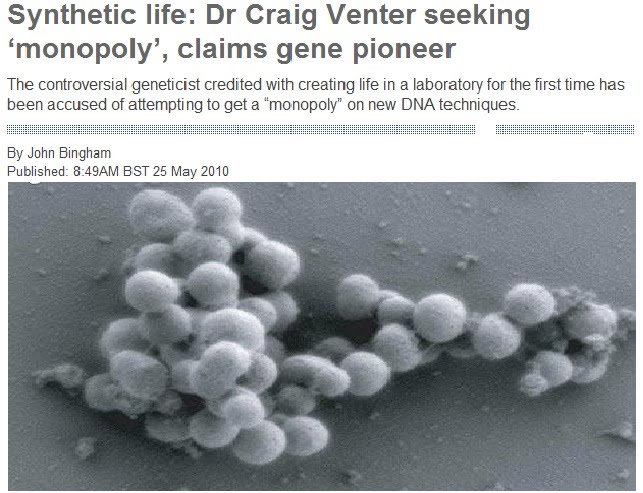 I've been following the reporting on Synthia, the so-called 'synthetic lifeform' or 'synthetic cell'. There's a lot of hype surrounding it, its creators, its promises and its dangers. Its very early days with this science and even earlier days in terms of applying the science ie technological uses - time for us to fully assess what it is and how we best employ it I hope.
Some impressive science is involved but its not really fully 'life made in the lab' because a naturally-occurring microbe, minus its genome, is used as the host and though the genome then inserted is synthetic it needed both yeast and E.coli to be used as part of the production of longer DNA sequences.
 The term 'life' has been applied with little or no reference the fact that there is huge debate about what life is. There is still a challenge for scientists and philosophers to define life in unequivocal terms. Defining life is difficult —in part— because life is a process, not a pure substance. Any definition must be sufficiently broad to encompass all life with which we are familiar, and it should be sufficiently general that, with it, scientists would not miss life that may be fundamentally different from earthly life...(more).
There's been talk of a 'new industrial revolution', bringing together together biology and engineering, using 'synthetic life' to clean up oil pollution and nuclear waste, taking climate changing human carbon emissions from the air, producing biofuels and new vaccines - and even human body parts! Interesting choice of problems caused by industrial revolution(s) that will be 'solved' by purely technical means due to another industrial revolution. Purely technical 'solutions' are all too often no solution at all - remember the technical promise of an 'unsinkable' Titanic, nuclear electricity 'too cheap to meter', freedom of movement via cars tempered by congestion and pollution, nuclear weapons that would deter still ever-present wars.
Technology certainly has a role to play in solving problems - we need it but it should meet the definition of being the practical means to live decently. We should be asking ourselves what proposed technologies are and undertake a rounded assessment of technical capabilities and limitations, cost-effectiveness and impact on working lives and various systems and environments now and on into the future. We need to question technical developments at the earliest possible opportunity as opposed to regarding them as unstoppable drivers of 'progress'. Unconditional surrender to inventions and novelties would mean we had no regard for any possible social, economic and environmental consequences. We need to consider - in a systemic and systematic way - how scientific and technical change can be best harnessed for individual, community, social and environmental good - but we are currently very poor indeed at this task!
Subscribe to:
Posts (Atom)