 Excellent news here: Bristol's residential roads to have blanket 20mph speed limit. At 20mph a pedestrian knocked over stands a greater than 90% chance of surviving. At 40mph they stand a 90% chance of dying! When traffic is slowed down to 20 mph, there is a 70 per cent drop in accidents to child pedestrians. A 20 mph speed limit on residential roads therefore makes a great deal of sense, so well done to all those who have brought this decision about. I hope all drivers will be responsible and adjust their speeds when they see the signs. See here for much more on the case for 20mph where people live.
Showing posts with label life. Show all posts
Showing posts with label life. Show all posts
Thursday, March 08, 2012
Safer speed
Excellent news here: Bristol's residential roads to have blanket 20mph speed limit. At 20mph a pedestrian knocked over stands a greater than 90% chance of surviving. At 40mph they stand a 90% chance of dying! When traffic is slowed down to 20 mph, there is a 70 per cent drop in accidents to child pedestrians. A 20 mph speed limit on residential roads therefore makes a great deal of sense, so well done to all those who have brought this decision about. I hope all drivers will be responsible and adjust their speeds when they see the signs. See here for much more on the case for 20mph where people live.
Labels:
20mph,
cars,
health,
life,
quality of life,
road safety,
security,
young people


Wednesday, February 01, 2012
PMQs Queries
 Today's Prime Ministers Questions featured some important matters of course...banking and bonus culture, reform of the NHS...As is most often the case however, the motivation for questions and answers is party politics and tactics - trying to get your opponent on the back foot. Very serious, highly topical matters that should be raised often dont get a look in.
No MP let alone Labour Leader Ed Miliband, asked about policy on Afghanistan despite the fact that overnight it was reported that a 'secret Nato report seen by the BBC suggests the Taliban in Afghanistan are being directly helped by the Pakistani security service (ISI).' (see full report and links to others here). This is a matter of life and death to our service personnel and Pakistan is supposed to be an ally.
Also no questions on the ongoing, unresolved economic crisis in Greece that could have widespread ramifications and where 'problems are as bad as ever.' (see here). Nothing on the prospect of famine in West Africa (here)...Ok, there is limited time and there are many serious issues that could be asked about - but there is a definite pattern to PMQs that severely narrows the topics chosen and the style and quality of debate.
Saturday, January 07, 2012
Safe systems?
The Evening Post headline 'Oldbury deemed safe' is misleading as it makes no sense to declare something 'safe' ie free from risk. This is not what the assessments of UK nuclear power stations have tried to do. What does make sense is to talk about degrees of risk ie the probability occurrence of various hazards. 'No major weaknesses' in UK nuclear stations is not the same as safe - better to say that certain risks have been found to be low probability. The development of life on Earth is thought to be an extremely low probability event - but here we are!
Friday, October 15, 2010
Water Words

Pairs of words that sum up a lot of water issues: life’s essential; renewable...potentially; community rooting; unevenly distributed; wasted widely; polluted commonly; rich, 100’s l; poor 10’s l; piped...UK; carried...Africa; city...leaks; extremely useful; farming, mostly; cooling, cleansing; ‘universal’ solvent; reservoirs, dams; socio-environmental havoc; community uprooting; climate changing; needs...wants; conflict prevention; modest measures; efficiency, accessibility; massive benefits!
http://blogactionday.change.org/
Labels:
blog action day,
blogging,
climate change,
community,
efficiency,
farming,
food,
life,
needs,
peace,
renewables,
violence,
war,
water,
wealth
Friday, June 04, 2010
Biodiversity is...
 Its International Year of Biodiversity this year so I'm going to do a series of articles on biodiversity in the run up to and a little beyond World Environment Day tomorrow. I've posted on topics relating to biodiversity many times before, notably here summarising the range of reasons why we should protect life in all its diversity and here illustrating the incredible variety of life to be found just within common fruit and vegetables, using the carrot as an example (click on the label biodiversity in the right hand column if you want to browse through my posts on this topic).
*
Some are unsure what is meant by biodiversity and it is all too often spoken of and explained as if its just about the range of species - its about so much more than that! This first post in the series thus gives my definition. Modern science has been and is learning about joined up - systems - thinking . Biodiversity is thus about the genetic variation within species, the range of all species, the interrelationships between species and between those species and their habitat(s) and the variety of habitats and ecosystems. Lets not forget that human beings are included in this of course and that the living world is tightly coupled to and dependent on the non-living ie water, rocks, air and so on. In short biodiversity is nature as a whole - and its the source of our resources and the basis of our lives - see biodiversity sample in the image above (click to enlarge).
*
The level of biodiversity is a key measure of how sustainable human society is - and should feature at least as much as the often discussed carbon emissions as an indicator. If biodiversity is high then we are much more likely to have: protected natural assets; kept ecosystems healthy; retained regenerative capacity; maintained the ability to deliver goods and services; kept wastes and pollutants below environmental capacity for safe processing.
Labels:
animals,
biodiversity,
environment,
life,
nature,
sustainable,
systems thinking,
trees
Thursday, May 27, 2010
Synthia: life, dont talk to me about life
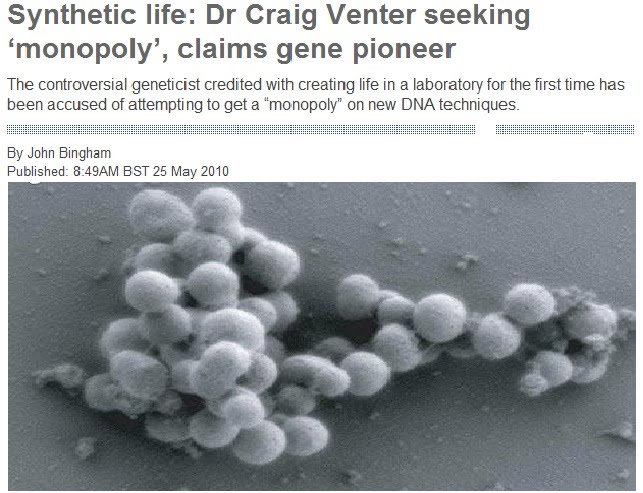 I've been following the reporting on Synthia, the so-called 'synthetic lifeform' or 'synthetic cell'. There's a lot of hype surrounding it, its creators, its promises and its dangers. Its very early days with this science and even earlier days in terms of applying the science ie technological uses - time for us to fully assess what it is and how we best employ it I hope.
Some impressive science is involved but its not really fully 'life made in the lab' because a naturally-occurring microbe, minus its genome, is used as the host and though the genome then inserted is synthetic it needed both yeast and E.coli to be used as part of the production of longer DNA sequences.
 The term 'life' has been applied with little or no reference the fact that there is huge debate about what life is. There is still a challenge for scientists and philosophers to define life in unequivocal terms. Defining life is difficult —in part— because life is a process, not a pure substance. Any definition must be sufficiently broad to encompass all life with which we are familiar, and it should be sufficiently general that, with it, scientists would not miss life that may be fundamentally different from earthly life...(more).
There's been talk of a 'new industrial revolution', bringing together together biology and engineering, using 'synthetic life' to clean up oil pollution and nuclear waste, taking climate changing human carbon emissions from the air, producing biofuels and new vaccines - and even human body parts! Interesting choice of problems caused by industrial revolution(s) that will be 'solved' by purely technical means due to another industrial revolution. Purely technical 'solutions' are all too often no solution at all - remember the technical promise of an 'unsinkable' Titanic, nuclear electricity 'too cheap to meter', freedom of movement via cars tempered by congestion and pollution, nuclear weapons that would deter still ever-present wars.
Technology certainly has a role to play in solving problems - we need it but it should meet the definition of being the practical means to live decently. We should be asking ourselves what proposed technologies are and undertake a rounded assessment of technical capabilities and limitations, cost-effectiveness and impact on working lives and various systems and environments now and on into the future. We need to question technical developments at the earliest possible opportunity as opposed to regarding them as unstoppable drivers of 'progress'. Unconditional surrender to inventions and novelties would mean we had no regard for any possible social, economic and environmental consequences. We need to consider - in a systemic and systematic way - how scientific and technical change can be best harnessed for individual, community, social and environmental good - but we are currently very poor indeed at this task!
Subscribe to:
Posts (Atom)