Showing posts with label technological assessment. Show all posts

Friday, June 15, 2012

Bendy buses

No comments:
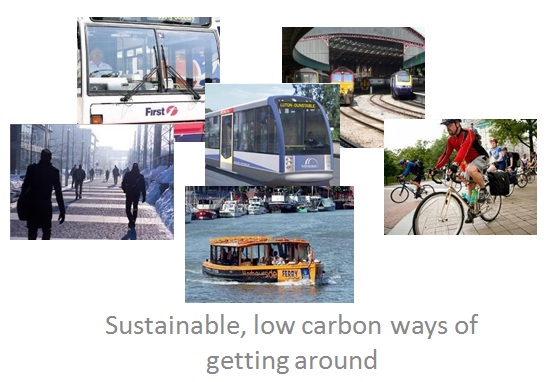
I'm an opponent of the current Bus Rapid Transit plans but as a keen advocate of communal, public transport I'd like to see investment in BOTH the Bristol bus and rail system (in addition to walking and cycling) and in combining all of these smoothly (see story and comments here).

Light rail is just about the most energy efficient form of motorised transport and it is likely to be more successful in getting car drivers to switch modes. However, it should not be a matter of rail vs bus, though I acknowledge that there is only so much money being made available.

FOSBR are right to oppose BRT, not least because of unsuitable routes and new roads,  but I'm not so sure about all their reasoning. The case I'd make against bendy buses is that they have potential problems with: insufficient effective motive power; slower speed and acceleration due to the extra weight; overheating leading to stalling, or even a fire if diesel fuelled; in crowded areas with narrow streets and tight turns the accident rate may exceed than conventional buses. Bendy buses are supposed to be highly fuel efficient but this must be dependent on the city and the system they are running on and so in practice I have doubts that they will be more efficient in operation than double deckers here in Bristol. Mind you some parts of FOSBRs rail alternative are non-starters - a tunnel under St Mary Redcliffe is both impractical and likely to be far too costly.

There is a problem with money availability if we are to invest in both buses and rail. Yet we need to invest several times what is available for BRT if we are to make a serious dent in Bristol’s traffic and traffic-related problems. It will be interesting to see how the Mayor elected in November approaches this. There is a problem with our congested roads because we need to make the existing bus system more effective and efficient and extensive, if we are genuinely trying to meet targets such as absolute traffic reduction and significant lowering of pollution - so are we willing to make a decent number of existing roads car and lorry free?? And would a Mayor be willing to bite this bullet?

More thoughts on sustainable transport here:

Sunday, March 25, 2012

Technology tale

No comments:
I'm an advocate of scientific and technological thinking. Many currently define technology far too narrowly though - and most often in terms of applied science, business and commerce. For more effective problem solving and opportunity taking we should be thinking more broadly and making connections - its more creative and more likely to anticipate consequences or potential consequences of actions.

Technology is not just about rational problem solving either, there are political, organisational and psychological dimensions. Technology is the sum total of our practical knowledge and it predates science, industrialisation, capitalism...Its something we need to learn to be more selective and controlled about adopting, through proper, thorough technological assessment processes.

Saturday, January 07, 2012

Safe systems?

No comments:
The Evening Post headline 'Oldbury deemed safe' is misleading as it makes no sense to declare something 'safe' ie free from risk. This is not what the assessments of UK nuclear power stations have tried to do. What does make sense is to talk about degrees of risk ie the probability occurrence of various hazards. 'No major weaknesses' in UK nuclear stations is not the same as safe - better to say that certain risks have been found to be low probability. The development of life on Earth is thought to be an extremely low probability event - but here we are!

Thursday, December 15, 2011

Bristol: Carbon City

1 comment:
Really Cllr Kent is deluded - he blows his trumpet very loudly indeed when he says Bristol will get the transport system it deserves. Cllrs love it when they can announce they've got money for something almost no matter what it is. For a start building a new road will ultimately add to the congestion and pollution existing now at high levels - its already very costly to business in pounds and costly to people in health and the environment in lost quality and quantity. Bus Rapid Transit is often not the best technology - and persistently asking just a few questions at public meetings on BRT reveals environmental decision making 'systems' that are simply not joined up thinking. Whatever happened to building a low carbon city with a high quality of life for all, the aim of Bristol Green Capital?

See http://www.bristol247.com/2011/12/15/bristol-to-finally-get-transport-system-it-deserves-15367/

Thursday, June 30, 2011

Optimism on sorting Bristol's transport problems

No comments:
The Bristol Evening Post says 'Bristol's metro is not as far off track as you might think'. I hope they are right and can help build up momentum for change on this issue. As many of my blog posts show I'm in favour of a Greater Bristol Integrated Transport Authority that implements a sustainable transport plan. History points to lack of agreement and cooperation between the local authorities though. If agreement and cooperation is reached they still need to get the process of decision making right: exploring the situation; formulating problems, opportunities and systems of interest; identifying feasible and desirable changes; taking actions; and re-exploring etc as appropriate. They need to fully involve as wide a range of people as possible right from the start, ensure good quality, comprehensive information is widely disseminated, get genuine cross-party and cross-organisational cooperation, agree the right goals, get finances sorted, assess technologies fairly and broadly, find a combination of technical, behavioural and socio-economic change that will consistently take us in a firmly sustainable direction... Its nothing like as straightforward and obvious as this Post report - which has a strong technocratic, techno-optimist slant - suggests.

Friday, June 24, 2011

Community Energy: 29 June Meeting in Knowle

No comments:
Joining up Bristol’s local community energy groups’ - Bristol Energy Network and the Centre for Sustainable Energy Present….

A meeting to hear a talk from Dan McCallum, Awel Aman Tawe Community Energy Successes from South Wales and to discuss what community groups can learn from their experiences


· Learn from what other groups across Bristol and the South West about what they are doing to help reduce energy use in their communities
· An opportunity for groups and individuals to share their projects and experiences
· Meet people from other energy groups across the Bristol and across the South West
· Find out how the Bristol Energy Network and CSE can support your project


Wednesday 29th June 2011 6.30 to 9pm, Knowle West Media Centre, Bristol. Refreshments and light food will be provided.


To book please e-mail Kirsty Mitchel, Kirsty.mitchell@cse.org.uk or phone 0117 931 4100
www.cse.org.uk/events/
www.bristolenergynetwork.org/events
All community groups are invited

Thursday, June 16, 2011

Living a one tonne life: update on research

No comments:
Update on this research received: Could a ‘One Tonne Life’ Make it Possible for Households to Reduce CO2 Emissions to a Level That Would Avoid Climate Change?


· Transport emissions drop more than 90%


· CO2emissions produced in the home halved


· Food carbon emissions reduced 84% by going vegan


· Manufacturing of house and goods prevents ‘One Tonne’


Stockholm, Sweden; Monday, 13thJune 2011: “One Tonne Life”, a collaboration project between A-hus, Vattenfall, Volvo Cars and other partners has shown that households could reduce their carbon output from 7.3 tonnes per person to a stable 2.5 tonnes per person, living a comfortable everyday life. Furthermore, more extensive changes prove that it is possible to get this figure down to just 1.5, a level that could help us become carbon neutral and avoid serious climate change according to
‘A One Tonne Future’.


In January 2011, Swedish family, the Lindells, embarked on this six month groundbreaking project to find out if they could reduce their carbon emissions to hit this important target. They were helped in a variety of ways, not least with a climate-smart house featuring solar cells on the roof that were used to recharge the electric car parked in the driveway. The family – father Nils, mother Alicia and children Hannah and Jonathan – undertook this inspiring journey which involved moving to a new, climate smart house and examining each of their everyday habits to find out where they could reduce or, indeed, eliminate their carbon emissions.


The family report that with their energy smart house, appliances, energy meter and electric vehicle, reducing their emissions to 2.5 tonnes did not require any major compromise in their everyday lifestyles. After that, however, things got tougher and living at the 1.5 tonne level was a tough compromise.


The family made most progress in transport and electricity consumption. Emissions from transport dropped by more than 90%, mainly due to the family’s Volvo C30 Electric being recharged with electricity from hydro-power. The family’s house, built by A-hus, produces its own electricity and,with supplementary renewable electricity from hydro-power, carbon dioxide emissions from purchased electricity reduced to almost zero. All told, carbon dioxide emissions from the family’s home were more than halved compared to their emissions level in their previous home.


The family also made immense progress through their eating habits. By meal planning and being more informed about the food we eat, varying the choice of meat and eating more vegetables, it is possible for people to reduce carbon dioxide emissions. Towards the end of the trial period, the Lindells ate only vegetarian dishes, and dairy produce was replaced with soya and oat-based alternatives.


In order to reduce their emissions still further, in the final 1.5-tonne week the family reduced the size of their home by closing off one room. They went without TV, shopping and eating out. However, their “rucksack” of 900 kilograms stopped them from reaching the one tonne target. This “rucksack” consists of the CO² emissions that take place when various products are manufactured, such as the house, solar panels, car, furniture and clothes. However, they demonstrated that it is possible to get very close to one tonne, however it does involve a change in lifestyle and the information to make the right changes.


Key features of the One Tonne house


The wooden “One Tonne Life” house has triple-layer walls with exceptional insulation, minimal air leakage and low-energy windows and doors. Through its solar photovoltaic system the house is a net producer of energy. All electricity not consumed by the family was fed into the national grid or used to recharge the electric car. The family’s Volvo C30 Electric emits no carbon dioxide at all when recharged with renewable electricity.


Household appliances account for up to half of a normal household’s total energy consumption, the house is equipped with the latest energy saving appliances from Siemens. To help track progress the Family had an ‘Energy Watch’ system that registers the power usage and compiles data for analysis. This allows consumption to be followed in real time or over a selected time period and learn how their personal habits influence electricity consumption. Experts from the Chalmers University of Technology followed the family in order to ensure a reliable calculation of the family’s carbon dioxide emissions. Methodology can be found here.


Further information and access to the project’s Flickr and Youtube account can be found here http://onetonnelife.com

Sunday, May 15, 2011

Historic climate change deal...observations

No comments:
Interesting story to say the least, with much of this climate change deal being most welcome. However amongst the quotes in it is this one where a 'senior government figure' said: "This country is now the world leader in cutting carbon emissions. We are the only nation with legally binding commitments past 2020." Excuse me but the UK has not cut its carbon emissions yet AT ALL, not even after 25 yrs of being 'signed up' to sustainable development!! See here and here on how UK carbon emissions have risen by 12% instead of falling by 15 or 16% as politicians have wrongly and misleadingly asserted. Its easy to talk the talk and spin your 'successes' and that's how conventional politicians work -but only real practical actions that achieve good outcomes solve problems.

The deal also includes 'carbon capture and storage technology – which would extract carbon dioxide from coal and oil plants and pump it into underground chambers'. This is not an established technology and of course it allows the ongoing use of mass quantities of fossil fuels which cause climate change.

Historic climate change deal with legal powers agreed by Cabinet Environment The Observer

Friday, April 08, 2011

Peoples message: energy saving and renewable energy not nuclear power

No comments:
Message I've just received from Friends of the Earth: 21,000 of you have now signed our petition for a safe and nuclear-free future . This fantastic support for clean, green power is backed up by a recent poll. 75 per cent of people want energy saving and renewables (like wind and solar) to be Government's top energy priorities. The petition has already travelled far and wide. But with big decisions about energy coming next month we want to organise an attention-grabbing hand-in to the Government. Please send us your ideas - as big and bold as you like. The message is clear : Energy saving and renewable resources can provide all the energy the UK needs. There's no need to gamble on nuclear. So put on your thinking caps! What's the best way to get our message across to Government?

Wednesday, February 02, 2011

FT.com / House & Home - Enlightened energy

No comments:
Hmmm...we have a south facing roof that might be suitable...so should we invest in solar photovoltaic panels or look into 'rent a roof' schemes? Interesting piece on this issue in the Financial Times.

“If you’ve got a bit of spare cash, it’s better to invest it in solar photovoltaic than putting your money in a building society,” says Charles Couzens, executive director of Ecos Trust, a Somerset-based charity that provides advice on sustainable building. He points out that you can get a healthy financial return of between 6 and 9 per cent, tax free.

The sea change for photovoltaic (PV) panels and other green electricity sources has come about through the introduction of feed-in tariffs in Britain in April 2010. This means that anyone installing small-scale electricity generation in homes, schools, hospitals or businesses can claim a substantial tariff – 41.3p a unit – for what they produce. And they get a further 3p a unit for any surplus electricity exported to the grid – as well as saving the cost of buying electricity in...

...in Germany, a national system of feed-in tariffs has turned a mostly cloudy country into a world leader in domestic solar panels. More than 250,000 people are employed in the industry and Germany is exporting components around the world...

...But what about people on lower incomes or those with young families who are unlikely to have enough money to spare? There is an alternative – a number of companies in the UK, and in other countries too, are offering consumers the chance to have solar panels installed and benefit from the energy they produce without having to pay a penny for them. Under most of these “rent-a-roof” schemes, the householder makes savings on their electricity bills, but gets nothing of the feed-in tariffs – these accrue solely to the panel owner...

FT.com / House & Home - Enlightened energy

Sunday, January 23, 2011

BBC - Richard Black's Earth Watch: H for 'human': The missing climate link?

No comments:
Governments reliance on technical solutions alone to cut carbon pollution causing climate change is doomed to failure. Technical progress tends to be straight line whereas environmental impacts are growing on an accelerating upward curve (geometrically, exponentially) - one thus cant keep pace with the other. Social, economic, political, behavioural and technical changes are needed in a coherent combination to cut carbon emssions to a level we can sustain. This includes: not thinking that issues can be summed up by a simple equation; tackling multiple causes through joined up thinking; and changing the attitude to wealth that currently dominates in particular.

As many commentators have pointed out down the years, virtually all the hopes expressed by governments in terms of reducing carbon emissions ultimately hang on technology.

It stems from the famous IPAT equation:
Impact = Population x Affluence x Technology


...sometimes expressed as...

Impact = Population x GDP/capita x Impact/GDP

BBC - Richard Black's Earth Watch: H for 'human': The missing climate link?

Thursday, January 13, 2011

Environment Agency - Viridor Waste Management Ltd

No comments:
Comments on the application for a permit for waste incineration due in soon...

Environment Agency - Viridor Waste Management Ltd

Name of applicant: Viridor Waste Management Ltd. Application number: EA/EPR/GP3834HY/A001 Type of regulated facility: Disposal of waste by Incineration. Address of regulated facility: Severn Road Resource Recovery Centre, Severn Road, Bristol, Avon BS11 0YU

The Environment Agency has received an application for an environmental permit under the Regulations from Viridor Waste Management Ltd.

The Environment Agency must decide whether to grant or refuse the application. If it grants the application, it must decide what conditions should be included in the permit.

Your chance to comment - Any comments should be made in writing by 09 February 2010

Tuesday, September 28, 2010

One Tonne Life

No comments:
One Tonne Life

Is it possible to live a One Tonne Life today?
One tonne of carbon dioxide per person and year is a major challenge bearing in mind that the global average today is about seven tonnes.
However, house specialists A-hus, power supplier Vattenfall and Volvo Cars believe that with the right know-how, the right technology and confident, consistent behaviour it is possible for the test family to approach the one-tonne target figure without departing significantly from its regular lifestyle or standard of living.
Much of the technology and the solutions the family will use are already available to the general public or will be in the near future. The necessary preconditions are there – right now!


According to The Independent 'Three Swedish companies are looking for an 'average' family to live in Stockholm for six months and reduce their environmental impact.' Click the link to find out more.

Tuesday, August 17, 2010

Avonmouth biofuel plant: appeal to Secretary of State

No comments:
Copy of email to Eric Pickles, Secretary of State for Communities and Local Govt and Chris Huhne, Secretary of State for Energy and Climate Change:
I made a statement to a Bristol City Council planning committee on 09/03235/F, the application for a 50 MW biofuel power station to be built in Avonmouth, Bristol by the company W4B. The application was rejected by the council but W4B have since appealed and a Planning Inspector has therefore been dealing with the matter during August 2010 (ref APP/Z0116/A/10/2126342). I urge you to fully consider my view on this matter as part of your deliberations.

It is my personal and professional opinion that the facts show that permission for this biofuel power plant should be refused. Proper public consultation and debate, with full and accurate environmental information, should take place before this proposal and any similar ones are even considered.

Bristol City Council and the applicant W4B have not supplied, early in the environmental decision making procedure, adequate, timely and effective environmental information and therefore provision for public participation has been inadequate – in fact completely absent for lengthy periods. The council has not complied fully and properly with either the letter or the spirit of Environmental Impact Assessment regulations, in particular as modified by the various EU Directives which enact the Aarhus Convention (see note 1 below). The council’s Green Capital/Green City policies clearly aim for best practice in this area but in this case at least it has not been forthcoming.
*
The Aarhus Convention is a relatively new kind of environmental agreement and enacting it enables a decision making body to deal well with the interconnected, interrelated nature of environmental, economic and social issues, such as those posed by this planning application. The Convention: links environmental rights and human rights; acknowledges that we owe an obligation to future generations; establishes that sustainable development can be achieved only through the involvement of all stakeholders; links government accountability and environmental protection; focuses on interactions between the public and public authorities in a democratic context.
*
Public authorities such as Bristol City Council are obliged, under the Convention and related EU Directives, to actively disseminate environmental information in their possession – but this has not happened for the whole of this application as there are many months when the only people who knew of the potential planning application and the planning officers opinion on environmental impact assessment are the officers themselves and W4B (who went away with privileged information and prepared a planning application).
*
The Area Planning Coordinator said this in an email to me on 16 Dec 09,
*
‘The applicant made a formal request to Bristol City Council as theLocal Planning Authority in February this year, to which Bristol indicated in April that it did not consider the proposals as set out inthe request to be EIA development. Whilst the applicant has proceeded inpreparing their planning application on this basis, this position wasnot however formalised until earlier this month (11 December 2009) whena formal Screening Opinion was issued in accordance with the EIARegulations. I have therefore attached a copy of the formal ScreeningOpinion of Bristol City Council as Local Planning Authority, for your information.’
*
The council made no attempt to actively disseminate the fact that a formal request (note: formal request) had been made. It made no attempt to disseminate the fact that it was minded not to consider the proposals an EIA development. Yet the environmental decision process has very clearly begun and the applicant has had the benefit of early information from council planning officers! Opportunity for public opinion and participation, including non-council experts, early on in the decision process were thus lost.
*
In fact, there was no opportunity for public participation in the screening process, the first stage in the Environmental Impact Assessment procedure, at all. The council gave what it says was its ‘formal’ opinion on December 11, identical to the opinion it gave the potential applicant in April 09, and only released the relevant letter to a very small selection of members of the public like myself on 16 December 2009 after we made a nuisance of ourselves through repeated phone calls and emails. So much for actively disseminating environmental information!!
*
Almost a year passed by (ie Feb 09 to mid-Dec 09) with no opportunity for public participation. Keep in mind the fact that the planning committee was close to having this application on its agenda in January!! As a result the many contributions people have been and are still making - a huge glut of observations and arguments – were all presented over a very short period of time, dealing with complex, interlinked, possibly unresolved issues. Properly abiding by environmental impact assessment procedures, as modified by the Aarhus Convention, taking on board the principle of early, environmental information and public participation is I believe what the council in obliged to do, is what its Green capital policy says it should do, and it’s the best practice way to have proceeded. Both council and company should be proactive in this regard.
*
Just some of the complex and interlinked issues (referred to above) are listed below:
*
*how to define what a renewable fuel from plants is (potatoes for human consumption are a renewable fuel source from plants if grown properly but another plant product like mahogany certainly would not be, or at least not on anything like the same basis);
*
*how to guarantee that any fuel supplied is renewable in practice (certification standards, inspection, independent verification…are in my view absent for the fuels proposed by the applicant);
*
*what a total carbon footprint is and how the carbon accounting is best done (the carbon footprint figures supplied by the applicant are not a total carbon footprint as this would require all direct and all indirect carbon emissions to be accounted for – but there are no figures supplied for land use changes and methane emissions associated with the fuels proposed, a major omission, and in fact several processes);
*
*whether cumulative air pollution impacts on people’s health and on the health of nearby designated sites is sustainable and would allow the Environment Agency to permit any power station given planning permission to operate (Avonmouth is already heavily polluted – see below).
*
The council view that no Environmental Impact Statement needed to be prepared is incorrect as well as being established with zero public participation. Officers wrongly concluded that were no impacts of significance. Even within the council officers narrow and irrational system boundary which does not acknowledge that the world’s ecosystems are interconnected, this fails to account for the effects of the power-plant on the Severn Natura 2000 Marine site, which are in fact of significance.
*
This area was selected against rigorous scientific criteria to protect the most threatened and important species and habitats in Europe, as described by widely respected organizations like the RSPB. The site is of international significance (UN RAMSAR listed, up to 100,000 birds over-winter there, Slimbridge Wildfowl and Wetlands Trust is just upstream). It is 450 yards from the power-plant site. It is protected with tough international limits for nutrient nitrogen deposition. Those limits are already exceeded in Avonmouth because of the traffic on the M5.That means only insignificant levels of nutrient nitrogen can be permitted by the Environment Agency if they are to give W4B’s power station an Operating Permit. Insignificant is defined as less than 1% of the Environmental Quality Standard.
*
The Environment agency have written to me on this matter saying:
*
> “There are some areas of Natura sites within 10km of the proposed installation> where the background deposition already exceeds the critical load. In this> case it would be difficult but not impossible to justify emissions above 1% of> the critical load. It is the responsibility of the applicant to provide such a> justification. The figures in the planning application suggest that there may> be such potential impacts but this is not certain at this stage."

I look forward to your reply (please note that I have published this email on my blog and would like to – and plan to - publish your reply on my blog).

Yours sincerely

Glenn Vowles, MSc, PGCE, BA
Associate Lecturer in Environmental Studies and Environmental Decision Making
http://vowlesthegreen.blogspot.com/

Notes
1. Two Directives concerning the first and second "pillars" of the Aarhus Convention have been adopted by the EU; …. implemented in the national law of the EU Member States by 14 February and 25 June 2005 respectively:
*
Directive 2003/4/EC of the European Parliament and of the Council of 28 January 2003 on public access to environmental information and repealing Council Directive 90/313/EEC
*
Directive 2003/35/EC of the European Parliament and of the Council of 26 May 2003 providing for public participation in respect of the drawing up of certain plans and programmes relating to the environment and amending with regard to public participation and access to justice Council Directives 85/337/EEC and 96/61/EC
*
Provisions for public participation in environmental decision-making are furthermore to be found in a number of other environmental directives, such as Directive 2001/42/EC of 27 June 2001 on the assessment of certain plans and programmes on the environment
Thursday, August 05, 2010

GAS generated at a sewage works in Avonmouth has been used to power a car.

3 comments:
GAS generated at a sewage works in Avonmouth has been used to power a car. It is believed the modified Volks- wagen Beetle, called the Bio-Bug, is the first vehicle in the UK to run on biogas from sewage sludge...

Interesting development. Its always worth putting such things into context. In this story what caught my attention most was this line,

'...The company claims waste flushed down the toilets of just 70 homes in Bristol would be enough to power it for a year, based on an annual mileage of 10,000 miles...'

Assuming these figures are accurate they give us a clear idea just how many UK cars could in theory be run on methane from UK human sewage ie a very small percentage of the total that currently exists. There are other non-fossil fuel sources of methane...animal waste, food waste of course but we are still talking about small numbers of vehicles potentially - unless we can get people to produce more sewage (after all Parliament manages to produce far more than its fair share).

Thursday, May 27, 2010

Synthia: life, dont talk to me about life

No comments:
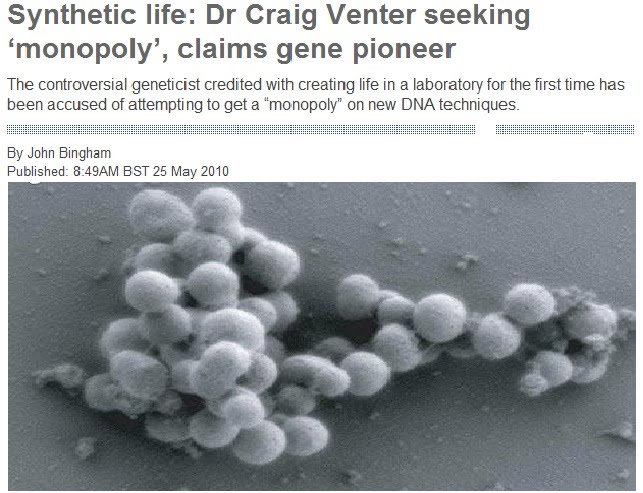
I've been following the reporting on Synthia, the so-called 'synthetic lifeform' or 'synthetic cell'. There's a lot of hype surrounding it, its creators, its promises and its dangers. Its very early days with this science and even earlier days in terms of applying the science ie technological uses - time for us to fully assess what it is and how we best employ it I hope.

Some impressive science is involved but its not really fully 'life made in the lab' because a naturally-occurring microbe, minus its genome, is used as the host and though the genome then inserted is synthetic it needed both yeast and E.coli to be used as part of the production of longer DNA sequences.

The term 'life' has been applied with little or no reference the fact that there is huge debate about what life is. There is still a challenge for scientists and philosophers to define life in unequivocal terms. Defining life is difficult —in part— because life is a process, not a pure substance. Any definition must be sufficiently broad to encompass all life with which we are familiar, and it should be sufficiently general that, with it, scientists would not miss life that may be fundamentally different from earthly life...(more).

There's been talk of a 'new industrial revolution', bringing together together biology and engineering, using 'synthetic life' to clean up oil pollution and nuclear waste, taking climate changing human carbon emissions from the air, producing biofuels and new vaccines - and even human body parts! Interesting choice of problems caused by industrial revolution(s) that will be 'solved' by purely technical means due to another industrial revolution. Purely technical 'solutions' are all too often no solution at all - remember the technical promise of an 'unsinkable' Titanic, nuclear electricity 'too cheap to meter', freedom of movement via cars tempered by congestion and pollution, nuclear weapons that would deter still ever-present wars.

Technology certainly has a role to play in solving problems - we need it but it should meet the definition of being the practical means to live decently. We should be asking ourselves what proposed technologies are and undertake a rounded assessment of technical capabilities and limitations, cost-effectiveness and impact on working lives and various systems and environments now and on into the future. We need to question technical developments at the earliest possible opportunity as opposed to regarding them as unstoppable drivers of 'progress'. Unconditional surrender to inventions and novelties would mean we had no regard for any possible social, economic and environmental consequences. We need to consider - in a systemic and systematic way - how scientific and technical change can be best harnessed for individual, community, social and environmental good - but we are currently very poor indeed at this task!