Showing posts sorted by date for query biofuels. Sort by relevance Show all posts

Thursday, July 19, 2012

Daniella debate

No comments:
Debate about Green Mayoral Candidate Daniella Radice on this post story eg by FOX_Joe - “Out to lunch bunch of daydreamers! Living in a bubble would be wonderful, but we don't. The most out of sync with reality 'political' party; in short communists with a slightly better education.”

My response: @ FOX_Joe - "Living in a bubble would be wonderful, but we don't."

Actually we do live in a bubble of sorts - the biosphere on our planet that provides all the resources that sustain our economy and society, has to take in all our wastes and pollutants and is the basis of our lives. Why call the people who plan to live sustainably and fairly in this bubble 'daydreamers' and unrealistic and not those who are squandering finite resources, blighting the world for future generations, building an economy that mainly benefits super-rich, corrupt and unethical bankers and their establishment politician and media friends and not general wellbeing...Your assessement is upside down FOX_Joe. Obviously I'm a green and so support Daniella and her policies but can you deny their rationale?

______________________________________________________

Copies of some further contributions I've made to the debate, which is pretty lively:

@ Richard34 - Daniella is proposing to go much further with devolving power than the current Neighbourhood Partnerships. She advocates creating - and Mayoral working with - democratically elected neighbourhood councils, which of course we dont currently have.

Current transport plans are hardly revolutionary and many aspects of the 'Greater Bristol Bus Network' and bus rapid transit - especially using bendy buses - have rightly been heavily critcised. There's been a lot of talk about public transport improvements in Bristol for decades and we have still got a lot of problems and a long way to go - thus the Greens proposals to create a major transport hub for local bus and train interchange at Plot 6 next to Temple Meads station and to develop the local economy in such a way as to improve local job creation, local shops and community facilities such that the need to travel long distances is cut.

On education Daniella will lobby the government to transfer the secretary of state's powers over free schools and academies to the Mayor, not to the council ie central government dictates are being opposed and local democracy favoured.

______________________________________________________

@ BCFC Finker - ok, still nothing on policies or principles, so no genuine substance to your comments. And dont forget that people will have two votes in the Mayoral election, one for first and one for second preference. People can therefore vote both with their heart and with their head. This may cause some interesting voting patterns, especially with the Lib Dems and Tories struggling due to the persistent failures of the Coalition Govt.
______________________________________________________

“@SouthvilleDav - Greens like Daniella and I have long been campaigning aginst biofuels - they simply aren't green at all - see http://tinyurl.com/88tf85o As for what you say on solar energy, you are absolutely right - and I'd go further and say that we should be investing in solar to grow the industry in this country so we can supply as much as we can for ourselves.
______________________________________________________

@ Richard34 - you are arguing against greater democracy and against democracy being closer to people instead of remote and in the hands of a few eg a single individual as Mayor. Its partly because democracy is not in people's hands in their neighbourhoods that voters have become disillusioned and politicians self-serving and unethical. There's nothing woolly about what Greens are proposing on this as neither you or anyone else have been unclear on what the plans are.

The current bus station is clearly badly located and our whole public transport system needs a redesign, including creating a proper integrated transport hub at Termple Meads, which is beginning to go through a redesign process anyway. We need to be much more ambitious with our integrated transport planning or we will never make a dent in serious problems of congestion, delay, air pollution, carbon emissions...Current plans wont make a dent in these problems and in fact will make some of them worse!!

Thinking that the current education system is 'wonderful' is a very big mistake. Conservatives once told us we needed GCSEs for instance and now have gone full circle to tell us we dont need them we need the old O'levels or similar!! Greens are not just talking about a transfer of power from central government to the Mayor but to the Mayor working in a partnership with neighbourhood councils and the parents, teachers, governors and pupils/students themselves given that the system is for them and their community not for ideologues in any political party, certainly in a remote central government. Lets have some parent, pupil and people power in the system.

Thursday, December 09, 2010

Bristol wins £260k green grant as biofuel decision delayed | Bristol24-7

No comments:
If sustainability - full and proper - is going to be used By Eric Pickles to judge this biofuel plan then I'm confident it wont go ahead.

Bristol wins £260k green grant as biofuel decision delayed Bristol24-7

...The news comes as it emerged that a decision on the controversial biofuel power plant planned for Avonmouth would be delayed by the Government.
Communities and Local Govt Secretary of State Eric Pickles was due to decide this month whether planning permission should be granted for the power station. He has announced a delay to allow all sides to submit more evidence on the central question – is it sustainable to burn biofuels to produce electricity?...

Wednesday, November 10, 2010

Research: biofuels significantly worsen climate change

No comments:
Britain's promise to more than double its use of biofuels by 2020 is "significantly" adding to worldwide carbon emissions, the Government admitted yesterday. Britain is signed up to a European guarantee to source 10 per cent of its transport fuel from renewable sources, such as biofuels, within the next 10 years.

But ministers have said that the policy is proving counter-productive and the greenhouse emissions associated with biofuels are substantially greater than the savings. They are now urging the European Commission to rethink the plan. The admission coincides with a major study published this week which concludes that biofuels will create an extra 56 million tons of CO2 per year – the equivalent of 12 to 26 million cars on Europe's roads by 2020.


This is because Europe will need to cultivate an area somewhere between the size of Belgium and the Republic of Ireland with biofuels to meet the target, which can only be done through land conversion – and more controversially, deforestation. The work will be on such a scale that the carbon released from the vegetation, trees and soil will be far greater than those given off by fossil fuels they are designed to replace.

The study, from the Institute for European Environmental Policy, found that far from being 35 to 50 per cent less polluting, as required by the European Directive, the extra biofuels will be twice as bad for the environment...

http://www.independent.co.uk/environment/climate-change/biofuel-plan-will-cause-rise-in-carbon-emissions-2129773.html

Tuesday, November 09, 2010

Letters: Greed not greens cause hunger | Environment | The Guardian

No comments:
Excellent letter in The Guardian:

Letters: Greed not greens cause hunger Environment The Guardian

The
Channel 4 documentary What the Green Movement Got Wrong (Last night's TV, 5 November) in our view made a series of misguided and inaccurate allegations and assumptions. It identified GM as a solution to hunger and implicated anti-GM campaigners for exacerbating food insecurity. As development organisations, we consider the documentary was extremely biased against environmental organisations that do so much to promote positive solutions. Hunger is a blight on humanity, but it is a political and economic problem. Its root causes include the broken and biased trading system; the bankers who gamble on the price of staple foods; and land grabs by financiers – all of which make food unaffordable for the hungry and deny their right to food.

In our view, the most significant impact that GM companies have made is to dominate the seed chain, selling expensive and patented seeds to farmers, seeds that are used more for livestock feed, cotton and biofuels – not for feeding people. The documentary didn't include any independent voices from civil society in the global south who are campaigning against GM and for local sustainable food production.

Had they done so, it is likely to have become clear that the small-scale farmers who provide food for most people in the world are not calling for GM technologies that are beyond their control. They are calling for political will from governments to take on the corporate lobbyists and protect their land, natural resources and production systems; a fair trading system to ensure fair prices; and a fair hearing from governments and documentary-makers on the future food system.

Deborah Doane
World Development Movement
Patrick Mulvany
UK Food Group
Andrew Scott
Practical Action
John Hilary
War on Want

Thursday, August 26, 2010

Bristol biofuel station: appeal for letters/emails to government and planning inspectorate

No comments:
Guest blog post from Zenith Milner: In Bristol,last year, a biofuels power station was planned and many of us have been working to campaign on it. We have worked hard and got petitions ,press, BBC... have lobbied councillors,and MPs and had demos and more.

Now the application has gone to a public inquiry. The decision now is going to be in the hands of Eric Pickles,secretary of state for communities and local government [email address bottom of this blog entry]. Maybe you have been involved, maybe not.

But even at this stage there is something you can do which could make a difference.

The biofuels company,W4B said in the public inquiry that there was very little opposition.So,please,dont let them get away with it. Please write in and say you dont want the power station in Bristol or anywhere else.

Issues include:


Lack of consultation with the public at every stage of the application for planning permission

Biofuels are not the green alternative they were first thought to be,they are the opposite.


Palm oil is often used and it causes widespread rainforest destruction -a holocaust where orang utans are shot their,babies are orphaned and injured; animals are burnt alive in their thousands as forest is cleaered by burning.Orangutans and,sumatran tigers face extinction as do many more species.


The Indigenous forest peoples are violently displaced from their land with homes and livelihoods ripped away from them.


Farmers are deceived into growing plants for biofuels and left with now way to feed themselves.

Shockingly,biofuels plunge millions more into hunger-an extra ten million in 2008.
No wonder Zeigler in the UN called them a " crime against humanity. "

Insanely the goverment massively subsidizes these power staions in a faulty opinion that they lower climate gas emmisssions, but the opposite is true.In fact along the whole life span of the biofuels, there are more emmissions than even fossil fuels.

The power stations would cause pollution in the locations in Britain they are planned for causing respiratory and heart disease ezcema and even infant mortality.THey are often planned for relatively deprived areas where people cant fight back so easily.

Truly green alternatives do exist;solar, wind,wave and tidal. Good insulation schemes would provide jobs as well as reducing consumption and carbon footprint.

For all these reasons and more,


Please write even a paragraph of an email [or letter, to the email/postal addresses below] to show that you do care, and prove the biofuels company wrong. And please encourage your friends etc to write too.

Many thanks
Zenith Milner


Ps I am intending to got to the Animals Rights Summer Gathering this weekend and give a workshop.about this issue. Do come along to find out more. Hope to see you there.

*Emails to
leanne.palmer@pins.gsi.gov.uk


*Letters to:
The Planning Inspectorate
Room 4/02
Temple Quay House
2 The Square
Bristol
BSI 6PN

*Appeal no. APP/Z0116/A/10/2126342/NWF

*Rt Hon Chris Huhne MP, Secretary of State for Energy and Climate Change
  
chris@chrishuhne.org.uk


*Rt Hon Eric Pickles MP, Secretary of State for Communities and Local Govt


Thursday, May 27, 2010

Synthia: life, dont talk to me about life

No comments:
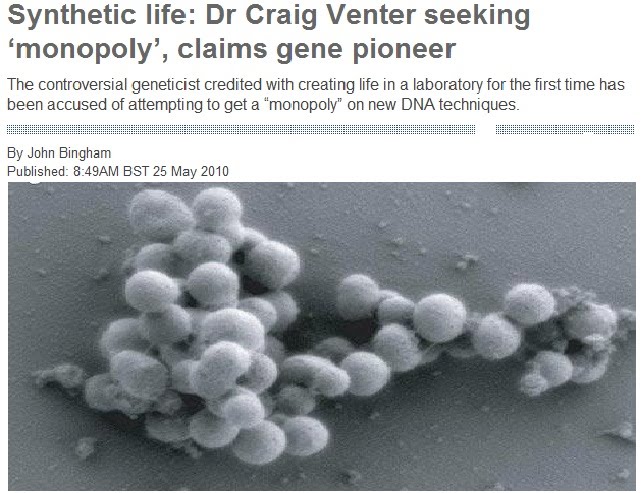
I've been following the reporting on Synthia, the so-called 'synthetic lifeform' or 'synthetic cell'. There's a lot of hype surrounding it, its creators, its promises and its dangers. Its very early days with this science and even earlier days in terms of applying the science ie technological uses - time for us to fully assess what it is and how we best employ it I hope.

Some impressive science is involved but its not really fully 'life made in the lab' because a naturally-occurring microbe, minus its genome, is used as the host and though the genome then inserted is synthetic it needed both yeast and E.coli to be used as part of the production of longer DNA sequences.

The term 'life' has been applied with little or no reference the fact that there is huge debate about what life is. There is still a challenge for scientists and philosophers to define life in unequivocal terms. Defining life is difficult —in part— because life is a process, not a pure substance. Any definition must be sufficiently broad to encompass all life with which we are familiar, and it should be sufficiently general that, with it, scientists would not miss life that may be fundamentally different from earthly life...(more).

There's been talk of a 'new industrial revolution', bringing together together biology and engineering, using 'synthetic life' to clean up oil pollution and nuclear waste, taking climate changing human carbon emissions from the air, producing biofuels and new vaccines - and even human body parts! Interesting choice of problems caused by industrial revolution(s) that will be 'solved' by purely technical means due to another industrial revolution. Purely technical 'solutions' are all too often no solution at all - remember the technical promise of an 'unsinkable' Titanic, nuclear electricity 'too cheap to meter', freedom of movement via cars tempered by congestion and pollution, nuclear weapons that would deter still ever-present wars.

Technology certainly has a role to play in solving problems - we need it but it should meet the definition of being the practical means to live decently. We should be asking ourselves what proposed technologies are and undertake a rounded assessment of technical capabilities and limitations, cost-effectiveness and impact on working lives and various systems and environments now and on into the future. We need to question technical developments at the earliest possible opportunity as opposed to regarding them as unstoppable drivers of 'progress'. Unconditional surrender to inventions and novelties would mean we had no regard for any possible social, economic and environmental consequences. We need to consider - in a systemic and systematic way - how scientific and technical change can be best harnessed for individual, community, social and environmental good - but we are currently very poor indeed at this task!


Monday, April 26, 2010

For animal wellbeing, opposing animal cruelty and suffering

No comments:
Completed Policy Questionnaire for Candidates in the 2010 General Election www.vote4animals.org.uk

Dear Candidate,

Please provide your name, party and the constituency you are contesting, delete ‘YES’ or ‘NO’ as appropriate, sign and date the questionnaire at the end, and return copies of completed questionnaire as soon as possible to (1) your constituent and (2) to PAD, 5th Floor, Alliance House, 9 Leopold Street, Sheffield S1 2GY; email
research@vote4animals.org.uk ; fax 0114 2722225.

Candidate’s Name, Party & Constituency:
Glenn Vowles, Green Party, Bristol East

1. Hunting Ban

Recent opinion polling confirms a clear majority of both rural and urban dwellers are opposed to hunting with hounds. The legitimate sphere of personal freedom does not extend to cruelty and violence towards others.


Will you support the Hunting Act 2004, oppose any moves to repeal this legislation, and support robust enforcement of the Act?

YES

2. Democratic Reform
The Animal Welfare Act does not cover animals used in agriculture and research. A situation has evolved over many decades whereby the Government takes decisions affecting millions of animals in closed policy processes dominated by commercial interests, with animal welfare considerations effectively excluded. The ethical concerns of the public are largely ignored, undermining democracy and public trust in politics. We need a democratically-accountable body to create a level playing field and ensure animal protection is given a meaningful voice in Government for the first time.

Will you support the establishment of an Animal Protection Commission with overall responsibility for all policies affecting animal wellbeing?

YES

3. Battery Egg Farming
Battery farming of eggs – involving around 30 million hens every year - is arguably the cruellest form of farming in the UK. Current EU plans to replace conventional battery cage with so-called ‘enriched’ battery cages by 2012 are inadequate. ‘Enriched’ battery cages share many of the serious welfare problems common to the conventional battery cage. A comprehensive ban on battery cages will complement the scheduled 2011 prohibition of de-beaking, which is a painful and unnecessary mutilation.

Do you support a full ban on all battery cages for egg laying hens in 2012 and the scheduled prohibition of de-beaking in 2011?

YES

4. Reducing and Eliminating Animal Experimentation
There is broad agreement that the infliction of pain on animals raises serious ethical concerns and that there are significant scientific limitations to the use of animal models as a guide to human biology. We therefore support the recommendation of the Home Office’s Animal Procedures Committee for a determined, targetted effort to bring about the end of animal use. In other policy areas, demanding targets have been identified as providing a goal even where these targets might require technological and other innovation if they were to be met. We believe in an analogous strategy in relation to animal use.

Do you support a strategy to identify and implement targets for the reduction and elimination of animal experimentation?

YES

5. Animal Experiments: Freedom of Information
Section 24 of the Animals (Scientific Procedures) Act 1986 blocks the publication of important information about animal experiments. PAD and the other major animal protection groups agree that researchers' names and addresses and genuinely confidential information should remain secret. Given that each animal experiment is only rendered legal through the authorisation by the Government, acting on behalf of voters, we believe that the public should be able to access all other information relevant to the ethics of animal experiments, including what is being done to the animals and for what purpose.

Do you support the repeal of Section 24 of the 1986 Act and the application of FOI to animal experiments, except for personal and genuinely confidential information?

YES

6. Biofuels and Animal Habitats
The preservation of natural habitats is crucial to protect the welfare of individual animals as well preserving biodiversity and other environmental benefits. Increasing demand for biofuels has proved to be a leading driver of deforestation in some of the most biodiverse places on earth, causing widespread suffering and death to many animals. Government incentives supporting the use of palm and other vegetable oils as fuel for transport, power generation and heating in the EU, are driving animals such as orangutans to the brink of extinction. Furthermore, the alternative source of biofuels is growing crops on agricultural land, which directly competes with growing food for people in areas where food scarcity is already a problem. Biofuels are not a sustainable solution to climate change, unlike truly renewable energy from sources such as wind, solar and tidal.

Do you support only giving subsidies to sustainable forms of energy production that protect animal welfare, and ensuring that biofuels with the exception of those sourced from true waste products (e.g. biogas from sewage) are not supported through targets and incentives?

YES

Wednesday, February 24, 2010

BBC Radio interview: biofuels for Bristol??

1 comment:
I've been on Radio Bristol this morning, interviewed about the biofuel power station planned for Avonmouth by company W4B. You can listen to the broadcast on BBC iPlayer by clicking here - I'm on right at the start, in the 6am news clip, then in an extended interview for 5 mins or so if you jump to approx an hour and ten minutes in (I think they used a clip from that interview on the 8am news, two hours into the program, too). Council Leader Barbara Janke and the BBCs Dave Harvey are also on the program from about 2hrs in.

Basically I've said that there are huge competing pressures for land use around the globe and that its immoral to take up land in poor countries that could be used to grow food,conserve wildlife and fight climate change, to fuel power stations in rich countries. Biofuels are not green as total carbon footprinting shows that they are more damaging as a fuel than coal and oil because of the land use changes (including mass deforestation) plus consequent emissions and the energy and chemicals used for intensive growing and processing.

There is no such thing as sustainable palm oil - and we have yet to properly define what a renewable fuel from such plants is. Plant types vary widely, from potatoes, to palm plants, to mahogany trees which no-one suggests are a renewable fuel source just because they take in carbon!! Renewability in practice is about proper and widely respected certification, inspection of plantations and processes and independent verification - this is not effectively provided by any agency at present and cant be put in place independently by a relatively small company like W4B (giant companies like Unilever are struggling with this issue, so smaller ones have little chance).


Biofuels in Bristol: decision day

No comments:
Statement on 09/03235/F, the application for a biofuel power station at Avonmouth which I will be presenting in person at today's planning committee meeting:

The facts say you have to refuse permission for this power plant. Bristol City Council and the applicant have not supplied, early in the environmental decision making procedure, adequate, timely and effective environmental information and therefore provision for public participation has been inadequate. The council has not complied fully and properly with either the letter or the spirit of Environmental Impact Assessment regulations, in particular as modified by the various EU Directives which enact the Aarhus Convention (see note 1 below). The council’s Green Capital/Green City policies clearly aim for best practice in this area but in this case at least it has not been forthcoming.

The Aarhus Convention is a relatively new kind of environmental agreement and enacting it enables a decision making body to deal well with the interconnected, interrelated nature of environmental, economic and social issues, such as those posed by this planning application. The Convention: links environmental rights and human rights; acknowledges that we owe an obligation to future generations; establishes that sustainable development can be achieved only through the involvement of all stakeholders; links government accountability and environmental protection; focuses on interactions between the public and public authorities in a democratic context. Public authorities such as Bristol City Council are obliged, under the Convention, to actively disseminate environmental information in their possession – but this has not happened for this application.

The Area Planning Coordinator said this in an email to me on 16 Dec 09,

‘The applicant made a formal request to Bristol City Council as the
Local Planning Authority in February this year, to which Bristol
indicated in April that it did not consider the proposals as set out in
the request to be EIA development. Whilst the applicant has proceeded in
preparing their planning application on this basis, this position was
not however formalised until earlier this month (11 December 2009) when
a formal Screening Opinion was issued in accordance with the EIA
Regulations. I have therefore attached a copy of the formal Screening
Opinion of Bristol City Council as Local Planning Authority, for your
information.’

The council made no attempt to actively disseminate the fact that a formal request (note: formal request) had been made. It made no attempt to disseminate the fact that it was minded not to consider the proposals an EIA development. Yet the environmental decision process has very clearly begun and the applicant has had the benefit of early information from council planning officers! Opportunity for public opinion and participation, including non-council experts, early on in the decision process were thus lost. In fact, there was no opportunity for public participation in the screening process, the first stage in Environmental Impact Assessment, at all. The council gave its ‘formal’ opinion on December 11, identical to the opinion it gave the potential applicant in April 09, and only released the relevant letter to a selection of members of the public like myself on 16 December after we made a nuisance of ourselves through repeated phone calls and emails. So much for actively disseminating environmental information.

Almost a year passed by (ie Feb 09 to mid-Dec 09) with no opportunity for public participation. Keep in mind the fact that this committee was close to having this application on its agenda in January!! As a result, as you can see from the many contributions people have been and are seeking to make, there is a huge glut of observations and arguments – all presented over a very short period of time and all dealing with complex, interlinked, possibly unresolved issues. Properly abiding by environmental impact assessment procedures, as modified by the Aarhus Convention, taking on board the principle of early environmental information and public participation, is what the council in obliged to do, is what its Green capital policy says it should do, and it’s the best practice way to have proceeded.

Just some of the complex and interlinked issues (referred to above) are listed below:

*how to define what a renewable fuel from plants is (potatoes for human consumption are a renewable fuel source from plants if grown properly but another plant product like mahogany certainly would not be, or at least not on anything like the same basis);

*how to guarantee that any fuel supplied is renewable in practice (certification standards, inspection, independent verification…are absent for the fuels proposed by the applicant);

*what a total carbon footprint is and how the carbon accounting is best done (the carbon footprint figures supplied by the applicant are not a total carbon footprint as this would require all direct and all indirect carbon emissions to be accounted for – but there are no figures supplied for land use changes and methane emissions associated with the fuels proposed, a major omission, and in fact several processes);

*whether cumulative air pollution impacts on people’s health and on the health of nearby designated sites is sustainable and would allow the Environment Agency to permit any power station given planning permission to operate (Avonmouth is already heavily polluted – see below).

The council view that no Environmental Impact Statement needed to be prepared is incorrect as well as being established with zero public participation. Officers wrongly concluded that were no impacts of significance. Even within the council officers narrow system boundary this fails to account for the effects of the power-plant on the Severn Natura 2000 Marine site, which are in fact of significance. This area was selected against rigorous scientific criteria to protect the most threatened and important species and habitats in Europe, as described by widely respected organizations like the RSPB. No document relating to this application even recognizes any site with such a designation. Yet the site is of international significance (UN RAMSAR listed, up to 100,000 birds over-winter there, Slimbridge is just upstream). It is 450 yards from the power-plant site. It is protected with tough international limits for nutrient nitrogen deposition. Those limits are already exceeded in Avonmouth because of the traffic on the M5.

That means only insignificant levels of nutrient nitrogen can be permitted by the Environment Agency if they are to give W4B’s power station an Operating Permit. Insignificant is defined as less than 1% of the Environmental Quality Standard. W4B and their consultants have not provided ANY data relating to nutrient nitrogen emission impacts on ecosystems.

The Environment agency have written to me on this matter saying:

> “There are some areas of Natura sites within 10km of the proposed installation
> where the background deposition already exceeds the critical load. In this
> case it would be difficult but not impossible to justify emissions above 1% of
> the critical load. It is the responsibility of the applicant to provide such a
> justification. The figures in the planning application suggest that there may
> be such potential impacts but this is not certain at this stage."

Natural England, consulted by the council, has not raised the issue of nutrient nitrogen and the reserve (at least not until time of writing = 18:15 Monday 22 Feb ’10) ­ thus failing to fulfill their role to provide statutory protection for it. The Joint Nature Conservation Committee the statutory adviser to Government on UK and international nature conservation, should, I believe have been consulted by the council but this appears not to have been done. Please reject this application.

________________________________________________________________________

Notes

1. Two Directives concerning the first and second "pillars" of the Aarhus Convention have been adopted by the EU; …. implemented in the national law of the EU Member States by 14 February and 25 June 2005 respectively:

Directive 2003/4/EC of the European Parliament and of the Council of 28 January 2003 on public access to environmental information and repealing Council Directive 90/313/EEC

Directive 2003/35/EC of the European Parliament and of the Council of 26 May 2003 providing for public participation in respect of the drawing up of certain plans and programmes relating to the environment and amending with regard to public participation and access to justice Council Directives 85/337/EEC and 96/61/EC

Provisions for public participation in environmental decision-making are furthermore to be found in a number of other environmental directives, such as Directive 2001/42/EC of 27 June 2001 on the assessment of certain plans and programmes on the environment.

Sunday, February 21, 2010

Bristol Biofuels Demo, Weds 24 Feb, 1pm, Council House

No comments:
STOP THE PLANNED PALM OIL POWER STATION AT AVONMOUTH! DEMO: Weds 24th Feb 1pm
Outside the Council House, College Green, Bristol.

Please bring banners, placards, costumes...

THEN JOIN US INSIDE FOR THE PLANNING MEETING AT 2pm WHICH WILL DECIDE WHETHER OR NOT THE PLANT GOES AHEAD.

EMERGENCY: growing palm oil causes RAINFOREST destruction, GENOCIDE of indigenous people, ANIMAL EXTINCTION, STARVATION through soaring food prices and worsens CLIMATE CHANGE and it is MASSIVELY subsidized by the government!


PLEASE COME ALONG AND BRING YOUR FRIENDS!
PLEASE SIGN THE PETITION ON THE LINK BELOW
Further info: http://www.acseb.co.uk/
Zenith on 0776 236 7351 or Martin on hoolie4@hotmail.com

Tuesday, January 26, 2010

Zero Meals Per Gallon...

1 comment:
I've been a supporter of Action Aid, through being a child sponsor and participating in a variety of campaigns for decades now. Today sent postcards (see copy in bold italic below) to Lord Adonis at the Dept of Transport and Ed Milliband at the Dept for Energy and Climate Change, supporting Action Aid's campaigning against industrial biofuels. We need to oppose the rush to use biofuels in cars and in power stations like the one proposed for Avonmouth (many previous posts on this). There are many genuine solutions to transport problems (proper investment in efficiency, light rail, local bus services, walking, cycling, local employment and shopping...) and energy problems (free insulation for all homes, wind, tidal and solar power...).

I don't want poor people's food pumped into cars. Action Aid estimate that the UK's continued commitment to biofuels will help push 600 million more people into hunger by 2020. What's more, your own review showed industrial biofuels could be worse for climate change than fossil fuels!

I want the Department for Transport to put the brakes on the increased use of industrial biofuels in the 2010 National Renewable Energy Action Plan, and concentrate on genuine solutions to the climate crisis, as a first step towards meeting my demand for Zero Meals Per Gallon.
*
Please consider going to Action Aid's website to see how you can support this campaign.
[Its worth mentioning that all political parties in Bristol except the Greens advocated and fully endorsed going for using corn starch plastic bags as part of the brown bin food waste recycling system - several posts about this. They also deprive people of land to grow food of course].

Tuesday, January 19, 2010

Two new web resources for biofuels & incineration...

No comments:
From Jane Stevenson: The new "Action for Sustainable Energy in Bristol" campaign site has background info on the proposed biofuel plant in Bristol, and details of how to object to its planning application:

The hearing for the biofuel plant application has been moved to 24 February, so there is still some time to register your objections.
Avonmouth is under seige from a raft of planning applications - 2 biomass power stations, 1 biofuel power plant and 2 incinerators. While both incinerators are planned for Avonmouth, one falls in the Bristol authority area, and the other in South Gloucestershire. Either of them, ON THEIR OWN, would delivery more additional waste capacity in the region, than we need to process our own waste - and that's leaving aside the fact that incineration is grossly inefficient in terms of recovering the maximum amount of energy from our waste. The applications seem designed to bring imported waste into the region, from areas where they haven't got their recycling act together.

Deadlines for objections are now quite tight, and seem to be a bit of a moving target. Current advice is to get your objections registered in January.
http://www.bambi-network.org.uk/pages/youdo.php

Monday, November 30, 2009

Biofuels for Bristol (??): Public Meeting this Thursday, 7pm, Arnolfini

No comments:
Despite serious concerns about the impacts of biofuels in general and vegetable oils like palm oil in particular on the climate, on forests and other ecosystems and on communities in the global South, as well as concerns over air pollution and public health in nearby areas biofuel (sometimes called Agrofuel) power station planning applications are springing up from a number of companies in several parts of the UK, including Bristol (more details on other parts of the UK from Food Not Fuel.

W4B Energy announced plans in April 2009 to build a 20MW power station at Balaclava Bay, Portland, Dorset. They were refused planning permission by Weymouth and Portland Council in September 2009 but have now submitted plans for a 50MW power station in Bristol at Avonmouth Docks, (application number 09/03235/F) as well as re-submitting plans in Portland. The Avonmouth plans are now being considered by Bristol City Council and a decision is expected as early as January 2010 (documents relating to the plans are here).

W4B are openly planning to use imported palm oil - Portland and Bristol are well suited to taking oil deliveries directly off tankers. The proposed power station would burn 90,000 tonnes of vegetable oil, most likely palm oil, every year.They have also put forward jatropha as a possible fuel - yet jatropha is not yet commercially available, many plantings are failing and thousands of people have already lost their land and livelihood for jatropha plantations to feed Europe’s biofuel market. A May 2009 report from Friends of the Earth demolishes the claims that jatropha can be sustainable because its grown on marginal lands with little need for water and fertiliser.

Unsustainable economics, unsustainable standards

Under the UK Government Renewables Obligation, companies producing electricity from renewable sources like solar, wind, hydro get a subsidy. This subsidy is also available for electricity generated in biofuel power stations. The allocation of this subsidy as 'Renewable Obligation Certificates' (ROCs) is the responsibility of OFGEM. Just as with biofuels used for transport, UK taxpayers are subsidising a false climate change solution – we just don’t have adequate standards and systems set up to guarantee socially and environmentally sustainable biofuel production at present.

At the moment, the only ‘internationally recognised certification scheme’ for imported biofuel feedstock is the Roundtable for Sustainable Palm Oil (RSPO). This has been strongly criticized for certifying palm oil from companies responsible for deforestation and peatland destruction, for decimating biodiversity (including orangutan populations) and for violating the rights of communities, including indigenous peoples. According to Greenpeace: “deforestation, deep
peat conversion, land disputes and illegal practices continue to occur in the plantation estates owned by a company that is RSPO certified for part of its operations.”
Walhi, Friends of the Earth Indonesia, has warned: "RSPO is designed to legitimate the continuous expansion of the palm oil industry, but any model that includes the conversion of natural habitats into largescale monoculture plantations will never be sustainable." and a declaration signed by 256 organisations condemns the RSPO for “greenwashing” inherently unsustainable oil palm plantations and practices by palm oil palm oil companies. Certification schemes for soya and other feedstocks are also being developed, and have been criticised on the same grounds.

The Royal Society report Sustainable Biofuels: prospects and challenges, Jan 2008, expressed serious concerns about unsustainable practices, lost opportunities, the need for proper sustainability criteria, the need for land use to be given greater priority and large scale uncertainty about current estimates of impacts, as this extract from the report conclusion shows

‘The dangers of producing biofuels in unsustainable ways have been highlighted, and it is taken as given that unsustainable practices will not be ‘exported’ by the UK through its import policies….However, there is a unique opportunity internationally, not only to avoid such problems, but to produce biofuels in ways that would help to restore degraded farmlands, woodlands, forests and watersheds. In order to facilitate this, the development of sustainability criteria for biofuels and land use need to be given greater priority and momentum in international negotiations. Furthermore effective mechanisms need to be put in place to facilitate technology transfer….Elsewhere in the report, we also highlight the significant uncertainty in the estimates of the impacts (environmental, social and economic) of biofuels.’

Unsustainable land use

The relatively small amount of electricity generated consumes a very large quantity of biofuel. In turn this requires an extremely large area of land to grow the crops, whether in the UK or abroad – land which already has many pressures upon it eg to grow sufficient food of good quality, to maintain varied animal and plant populations, to maintain the ability of land to process carbon, various nutrients and water, to provide healthy leisure, educational and recreational opportunities for people, for housing, roads and so on. Food Not Fuel go through the figures here, stating ‘Ten power stations would be using 67,000 hectares - a land area that could feed a city the size of Belfast!’

Unsustainable climate impacts

Campaigners are very concerned that when full and proper carbon equivalent accounting is done burning vegetable oils emits up to 70% more greenhouse gas emissions than diesel oil - even if it is grown in the UK. A 2007 study by chemistry Nobel laureate Paul Crutzen and others suggested that the use of rapeseed biodiesel was associated with 70% more greenhouse gas emissions than the use of equivalent amounts of mineral diesel, due to nitrous oxide emissions from synthetic fertilizer use. Nitrous oxide is nearly 300 times as powerful a greenhouse gas as carbon dioxide.

Peat expert Professor Siegert of Munich University has said about palm oil power stations in Germany: "We were able to prove that the making of these plantations and the burning of the rainforests and peat areas emits many thousands of times as much CO2 as we then are able to prevent by using palm oil. And that is a disastrous balance for the climate."

Unsustainable social and health impacts

The environmental and social impacts of using imported vegetable oil, typically palm oil, are worse. This Biofuelwatch paper explains clearly why the UK agrofuel power industry is likely to import at least some of its fuel, and why this is more damaging.

Burning vegetable oil in power stations, whether grown in the UK or imported, results in high emissions of nitrogen-oxide gases, which can cause or worsen asthma and other lung diseases. It could also cause more emissions of tiny air-borne particles (known as PM 2.5) linked to premature deaths from heart and lung diseases and possibly cause more cot deaths in babies. The Blue NG power stations in Beckton and Southall are both in urban areas with crowded streets and road traffic congestion, and close to airports, where air quality is already not good – as is the case with Avonmouth!

The ravenous need for crops, such as palm, to create the oil required for these stations, often results in violent evictions of indigenous peoples and peasant farmers who receive no compensation, and have no where else to go. With them, thousands of species are threatened with extinction, including the orangutan, and Sumatran tigers and elephants.

In a world where one in six people are in hunger, ie one billion, industrial scale biofuels, which mean that more and more land is used for fuel, rather than for food, are condemned as a "crime against humanity" by the UN’s Jean Zeigler (see here for details).

These stations are planned around the country including Avonmouth, Bristol with minimal or no public consultation. The provision of environmental information is often very poor, making effective participation difficult eg there is still no environmental impact statement available for the proposed Avonmouth power station.

It will make world food prices higher as vegetable oil will be used for electricity instead of food. People in other areas of the world, like South-east Asia and South America could be displaced from their homes to allow the necessary vegetable oil plants to be grown.

Monday, November 23, 2009

Biofuel power for Bristol would very seriously detract from 'green capital' ambition

No comments:
Biofuels Scandal: The Hidden Cost of the Biofuels Stations proposed for Bristol and for sites across Britain. Public Meeting organized by Zenith Milner, Environmentalist, Thursday 3rd December, 7:00pm to 9:00pm, The 3rd Floor, Bush House, Arnolfini, 72 Prince St.,Bristol, BS1 4QD

Heavy government subsidies, to the tune of tens of millions of pounds of taxpayers' money, are all that are making power stations using virgin plant oil viable. But the truth shocking is that, instead of reducing the gases that cause climate change, these biofuels stations actually increase them. Also, they cause local air pollution, causing respiratory and heart diseases and they bring about rainforest destruction on a massive scale.

The ravenous need for crops, such as palm, to create the oil required for these stations, often results in violent evictions of indigenous peoples and peasant farmers who receive no compensation, and have nowhere else to go. With them, thousands of species are threatened with extinction, including the orang utan, and Sumatran tigers and elephants.

In a world where one in six people are in hunger, ie one billion, industrial scale biofuels, which mean that more and more land is used for fuel, rather than for food, are condemned as a "crime against humanity" by Jean Zeigler, UN. But a number of these stations are planned around the country including Avonmouth, Bristol [despite its 'green capital' ambition - Ed] with minimal or no public consultation.

You are invited to come and voice your views on whether we should build biofuels power stations in this country. We hope to have representatives from Southall, Portland and Newport campaigns on biofuel power station applications with us.

Come along and bring friends and colleagues with you and let others know about it - lets get those councillors and MPs can candidates for such posts attending. Write to them and invite them – they may send a representative if unavailable themselves as has already happened.

Saturday, November 07, 2009

Call for action against proposed Bristol biofuel power station: meeting Thurs 12 Nov

No comments:
I've been in touch with Zenith Milner, campaigner against virgin biofuel power station proposals, such as the one planned for Avonouth (one of many applications all over the UK). Please support her call for action - the coming weeks and months are a vital time, with planning applications being considered here. Zenith said,

Please come to our urgent meeting this Thursday 12 November to oppose the plan for a new virgin biofuel power station at Avonmouth, Bristol. Meet at 6.45 for 7 at the entrance of Coexist, 80 Stokes Croft, Bristol, B31 3QF.

W4B has plans to build a power station that would use palm oil and jatropha i.e. virgin biofuel. The plant would have devastating environmental and social consequences. These would include local air pollution from nitrous oxides and particulates which cause respiratory and cardiac diseases, ezcema and may even be related to cot death. Burning vegetable oils would lead to more climate change gases - carbon dioxide and methane - than burning even fossil fuels. Rainforest destruction would be caused, leading to violent evictions of indigenous peoples and the killing and endangering of animal species such as orang utans, sumatran tigers, sumatran elephants and many more. Using land for biofuels instead of food in a world where one billion (or 1 in 6) people are going hungry should be unthinkable. Jean Zeigler, the UN special rapporteur on the right to food, said it was a crime against humanity to divert arable land to the production of crops which are then burned for fuel.

The scandal is that this type of power station is only viable due to heavy Government subsidies to the tune of tens of millions of pounds of tax payers money. It is also outrageous that there has been virtually no public consultation here in Bristol, which is why so few people know about it even in a city where there is so much environmental awareness.

Consultation has also been minimal in other towns where plans for biofuel power stations have been submitted. However, when citizens have been made aware of the plans they have expressed strong opposition and supported successful campaigns that have led to planning committees rejecting the proposals in Southall, Newport in Gwent and Portland.

It is vital that Bristol shows the way by rejecting this application for a biofuel power station here in Avonmouth and making a stand against virgin biofuel power stations in general in this country.

Please join our EMERGENCY CAMPAIGN MEETING this THURSDAY 12 NOVEMBER at 6.45 for 7 at the entrance of Coexist, 80 Stokes Croft, Bristol, B31 3QF.

Please sign the online petition against the power station at
http://epetitions.bristol.gov.uk/petition.php?id=302

Do get in touch with Zenith at
zenithswifter@yahoo.co.uk if you can help with the campaign or want any further information

For further information about biofuels:
http://sites.google.com/site/foodnotfuelorg/
http://www.biofuelwatch.org.uk/

Friday, October 09, 2009

Oppose this unsustainable, ungreen biofuel power station plan for Avonmouth

4 comments:
Just joined the Facebook group Stop Bristol's Biofuel Power Station because I'm very strongly opposed to power stations that plan to burn non-recycled and imported biofuels produced with massive social and environmental impacts. I've sent the group's suggested email of objection to the planning application (Ref 09/03235/F) to: development.management@bristol.gov.uk and urge others to send similar messages.

Dear Sir/Madam,

Re: W4B Renewable Energy application for a biofuel power station at Avonmouth Docks, Ref 09/03235/F

I wish to object to W4B’s planning application to build a 50 MW biofuel power station at Avonmouth Docks, which would burn 90,000 tonnes of vegetable oil every year. I am deeply concerned about the impact of biofuels such as palm oil on the climate, on rainforests and other ecosystems and on communities in the global South. In Italy and Germany, a large number of biofuel power stations are already operating and virtually all of them run on palm oil which is by far the cheapest vegetable oil. Jatropha oil, also mentioned in the application, is not available commercially so far, yet already many thousands of people in Tanzania, Ghana and India are losing their land, livelihoods and in some cases their forests to jatropha plantations.

If the power station were run on palm oil only, it would require over 22,000 hectares of plantations – and even more for any other feedstock. According to the UN, palm oil is the main cause of deforestation in Indonesia and Malaysia. It is responsible for billions of tonnes of carbon emissions, as forests are destroyed and peatlands converted to plantations. In countries like Indonesia, Papua New Guinea and Colombia, growing numbers of indigenous peoples, small farmers and other rural communities are being forced off their land, often through violence.

Bristol City Council must consider the climate and wider sustainability impacts of planning decisions and I believe that this means that the development should be rejected.

I am also concerned about the impacts of the proposed biofuel power station on air quality and thus on the health of the local population, particularly in Avonmouth but potentially also in Hallen Village and Severn Beach Village. Avonmouth is already designated as an Air Quality Management Area, with concerns over PM10 levels. The power station will worsen PM10 levels, as well as those of NOx and PM 2.5, and will add to the pollution from two large biomass power stations in the area for which plans are currently being considered.
*
*
*
Local news reports on the issue:
*
There is also an e-petition opposing the power plant - please sign it!!

Tuesday, February 17, 2009

Our carbon footprints

6 comments:
Climate change is a serious and urgent issue (report on the latest science here). Carbon emitted faster than it is absorbed is causing it. Thus the rising focus on carbon footprints as an indicator of environmental impact. We can both assess the scale of the problem and then monitor progress towards target low emission levels. The average personal carbon footprint in the UK is currently 12 tonnes per year (in the USA its 20 tonnes). A key provision of the UK’s Climate Change Act 2008 is a cut in emissions of at least 80% from 1990 levels by 2050. To achieve sustainable UK emissions, allowing for rising population, we are talking about between 1 and 2 tonnes per person each year.

Its not just carbon in the form of carbon dioxide emitted when fossil fuels are burned that is counted. All emissions that add to the greenhouse effect and cause climate change are converted to their carbon dioxide equivalent and expressed in tonnes or kilograms of this gas (a footprint in tonnes may seem odd but that’s because the name is drawn from the ecological footprint). Gases converted to their carbon dioxide equivalent include methane, nitrogen oxides, various hydrocarbons.

Carbon emissions arise through fuel use for heating, lighting and transport. These are direct and we have reasonable control over them. Emissions also arise less directly because they are embedded in the products and services we use, from the production and disposal ends of their lifecycle. Its harder to have control over these though of course we can alter the type and number of products and services we consume.

Picture a system boundary around a city, a person, a house, factories, offices, a country, group of countries – the carbon footprint of each can be assessed. A boundary can be drawn around various products, say beef or cars, and the carbon footprint of the product’s lifecycle assessed. Organisations want to know their carbon footprint for energy and/or environmental management purposes, prioritising and quantifying effective, efficient and economic action. Growing numbers use the data in corporate social responsibility reports, responses to customer and investor requests. Organisations as diverse as Ipswich Town Football Club and Marks and Spencer have carbon neutral policies. Carbon footprint figures are appearing on a range of products, including Walkers crisps, Innocent Drinks smoothies and Boots shampoo…to enable informed consumer choices.

The carbon footprint concept is itself inevitably a simplification of reality. The computer models used to calculate footprints are further inevitable simplifications. This is both a plus and a minus of course. As with all measurement and calculation, care and preparation is needed when establishing and reporting figures. Independent verification may often be appropriate. Caution and checks are needed to ensure fair comparisons. Footprint standards are bringing methods closer together, making data more consistent and comparable.

Carbon footprints relate to one key environmental impact - climate change – and according to the Global Footprinting Network amount to half the ecological footprint (and not all types of environmental impact can be converted to the land area ecological footprints establish). This is a very significant proportion of the ecological footprint and so it is essential to establish it. However, we must not forget the other ways we are breaching environmental limits as measured by: overfishing; socio-economic effects; deforestation; species extinction; our water footprint; the spread of monocultures; deaths due to toxic pollution; quality of life reduction from noise and visual impacts, and more.

Sustainability is a whole system phenomenon. Types of impact are interrelated. If we don’t take a whole system approach to finding solutions our actions may be ineffective or cause further damage through effects we did not intend or anticipate. The dash for biofuels provides a timely lesson for us. Carbon footprinting is an excellent tool for awareness raising, getting a sense of the overall scale of the problem and progress made toward reduction targets but we must combine it with other measures and make good judgements on how problems interlink.


Friday, June 06, 2008

Biofuels, food prices, biodiversity, Spiderman, meat - or the connection between them all??

No comments:

I've wondered, should I decide to post today, world environment day, just what I would write about.

Perhaps the latest warnings about biofuels causing higher world food prices as discussed at the UN food summit in Rome, featuring strongly on the BBC news this evening?

Or the recent report 'The Economics of Ecosystems and Biodiversity (TEEB)', described as the first major report to outline the economic impact of cutting the variety of life (severe impacts on the worlds poorest and costs of up to £40 billion every year, 7% global GDP decline by 2050 if ecosystem damage is not tackled...) ?

How about saying that Alain Robert, the French Spiderman, has today been in New York City climbing a huge skyscraper to promote the message that we need real leadership on climate change from the G8 countries meeting next month (According to him "The Solution Is Simple":
1 – Stop Cutting Down Trees. Plant More Trees. 2 – Make Everything Energy Efficient. 3 – Only Make Clean Energy.).

I'm conscious that I've not posted much on the subject of diet and environmental impacts, in particular the amount and type of meat eaten, so perhaps something on this topic, reasonably well discussed on Newsnight a few days ago following comments from the head of the UN climate agency, Yvo de Boer, who is attending UN-led climate talks in Germany this week that we should all become vegetarians. After all in times of high food prices should we, at great environmental cost, be feeding grain to cows and pigs instead of people?? I really like meat but its a highly inefficient food to produce and consume and I acknowledge the very strong ethical, ecological, economic and health case for vegetarianism and veganism (I try to keep my meat consumption right down - I'm not a veggie).

Interesting how intimately intertwined issues of environment, energy, economics, food, climate and personal choices/behaviour are isn't it.

Wednesday, May 07, 2008

Row over the introduction of corn starch bioplastic bags in Bristol is the wrong row to have!!! The council seems to be ignorant of world events.

No comments:
There should indeed be a political row over introduction of corn starch bioplastic bags for use in the city's brown bin recycling system - but it certainly should not be this one! Squabbling over the details of how they are introduced shows just how little the bigger political parties truly understand what it means to be green ('Political Row Over Bags for Food Scraps', Bristol Evening Post, 7 May 2008).

Clearly the bags should not be introduced at all and we should continue to contain brown bin food waste in material that already exists, such as used newspaper or other waste paper such as paper bags. Just like the push for biofuels has helped to force up food prices so has the push for bioplastics. In addition just as there is great controversy about how biofuels actually increase environmental impacts instead of decreasing them, so the same argument applies to bioplastics. As soon as you start to grow crops for turning into fuel or plastics you are competing with food production and are clearing land as well as using chemicals and fossil fuels for the farming and processing. (There are a multitude of news stories about this issue eg here and here).To be sustainable biofuel and bioplastic production should be from waste oils and fats that already exist.

Council policy on making corn starch bags available, originally spearheaded by Knowle Lib Dem Cllr Gary Hopkins, which all parties apart from the Greens agree on, is based on ignorance of the facts I'm afraid. Don't councillors follow current events by at least watching the news??

Wednesday, April 30, 2008

Vote green for: boosting the local economy; a stable, secure and healthier life; communities that can be sustained; fresh politics!

1 comment:
Copy of my letter below (published in today's Bristol Evening Post), as sent recently, urging voters to reject tired old politics and vote Green. Its a very big day for the Green Party with voting taking place across the country tomorrow (see http://votegreenparty.org.uk/ and http://sianformayor.org.uk/). Greens are on the up - with over 700 candidates standing, a major national newspaper (The Observer) calling for voters to support Sian Berry for London Mayor, and high hopes for continued and even stronger performance in places like Stroud, London, Norwich and elsewhere - so watch this space later this week for comments on results.

______________________________


It should be no surpise that food prices are rising, causing many problems here and around the globe, especially for those already extremely poor of course. The problem is that in practice countries have done nothing to create economies that can be sustainable, economically and environmentally. World population has more than doubled since 1950, stimulating demand.


Consumption in countries like the UK and USA is sky high, whilst consumption is very rapidly rising in places like China, India and elsewhere, resulting in fuel use which has more than quadrupled since 1950. More demand for fuel means higher prices.


We have speculation in the wheat market by 'investors' (gamblers). Growing world meat consumption and the use of land to grow plants for biofuels and bioplastics instead of food, in the deeply mistaken belief that it is a green action, has pushed food prices up by stimulating demand.


More people, more fuel use, more resource consumption, more land taken for farming, emissions and efficiencies due to rising meat consumption and the rise in transport intensive lifestyles has resulted in climate change. In turn droughts and floods from climate change have lowered food supplies in key places, putting upward pressure on food prices.


Yet despite what seems to me to be a viscious circle the big political parties continue to promote the same old economic expansionism, high and growing consumption and increasing global trade. In contrast it is economic localisation that we need here and around the world. A stable, secure and affordable economy would result from this approach, creating a conserver society. Our health and general wellbeing and that of our environment would also be much better in such a society and it could be sustained on into the future and around the globe. Voters should thus reject the same old politics, advocating the same old economics from the same people and parties.

More on economic localisation here.