
Wednesday, June 23, 2010
Monday, June 21, 2010
Government 'action' on biodiversity?
 A sixth mass extinction of species is underway according to those scientists who study this field. Even Bjorn Lomborg said in his book The Skeptical Environmentalist that the current/recent extinction rate is high (his figure = 0.014 % of species per year, compared to the background/natural extinction rate of 0.0001% per year ie even a 'sceptic' says it is 140 times greater). Large numbers of scientists put the extinction rate at ten or even a hundred times Lomborg's figure, which is why they talk of a sixth mass extinction: being underway; being very rapid compared to previous mass extinctions (see image, click to enlarge); being caused largely by human activities, especially since industrialisation.
Given this, how are our government reacting? What are they doing/planning to do? Not that much - certainly not enough! You can scour over this speech by the new Environment Secretary Caroline Spelman but you wont find much about action on biodiversity apart from acknowledging interdependence and generalities on wanting to make things better (the emphasis is in fact distinctly on other matters, like money). Lets hope that this is just down to it being early days for the new government. Spelman's department, defra, said this very recently about UK biodiversity assessments /measurements,
Of the 34 component measures within the indicators, over the long-term 10 have shown deterioration, 9 have shown improvement, 2 have shown little or no overall change, 12 had insufficient data for an assessment, and 1 is provided for contextual information and is therefore not assessed.
Not good. Note that by over the long term they appear to mean from the 1970s on! Figures comparing current biodiversity with pre-Second World War, pre- First World War or even pre-industrial levels would be very interesting, though the further back in time we go the harder it is to get reliable data. I'm not that impressed by the current way we gather, treat and use data either.
http://www.jncc.gov.uk/biyp/
http://ww2.defra.gov.uk/files/2010/05/1905biodiversity.pdf
Friday, June 18, 2010
Food security and the variety of life
 Ask local and national govt about biodiversity and they will talk about species and habitats. Fine as far as it goes, there’s much to be done about both and too little action being taken. I’ve talked about loss of species previously. According to The Ecologist since the Second World War our country has lost 95% of flower-rich meadows, 30% of ancient woodland and 80% of lowland grassland. We’ve lost many thousands of miles of hedgerow, home to a significant proportion of our plants,mammals, bird, butterflies.... The World Resources Institute say that the worlds forest cover has shrunk by as much as half, that 58% of coral reefs are threatened, that two thirds of cropland suffers soil degradation to some degree. You dont hear enough about biodiversity at the genetic level though – and that’s vital to human welbeing, not least because it gives plant and animal breeders a resource to draw on to feed the world.
 Within each species and sub-species exists a unique pool of genetic codes. This pool has enabled plants and animals to adjust to change ie its evolved by natural selection. This diversity is what gives our food its flavour, food value, resistance to disease, adaptability... We are allowing this pool – an invaluable resource - to diminish, cutting what we can draw on to develop plants and animals for food in the face of environmental change. Two very common foods –potatoes and wheat - illustrate the situation well.
The original home of the potato is the Andes, South America. Breeders are continually looking there for new genetic material – but as natural and semi-natural areas are cleared, built on, farmed and so on the range of genetic material is decreasing. Andean farmers have increasingly been encouraged to discard old potato varieties for newer, higher productivity ones. Artificial gene banks of seeds and living material are likely to be no substitute for the real thing! There is enormous value in preserving and growing traditional varieties and in protecting natural areas, preserving genetic material where it has developed.
 Giant and powerful agrochemical and agribusiness interests are disregarding biodiversity, at genetic, species, habitat and ecosystem levels - and dominating the seed trade. Reducing variety – ideally to a few patentable, single-season, expensive cross-breeds, dependent on fertilisers and pesticides – makes sense and makes money for giant transnational companies. Those who dominate the seed trade also make the chemicals! Where they once used to be varied, wheat and corn aren’t so now - 30% of the worlds wheat comes from one parent plant and 70% of the corn comes from six parent plants. Narrow genetic variation means lower food security because in the event of plant pests/diseases successfully attacking wheat/corn we could lose a big chunk of what is grown.
Labels:
animals,
biodiversity,
environment,
food,
nature,
security


Wednesday, June 16, 2010
Gardens and wildlife: biodiversity 'begins at home'
 There are around 15 million gardens in Britain and those in England cover an area larger than all nature reserves. Gardens often support more variety of life than the green belt and have long been vastly underrated and underemphasised in biodiversity action planning! Help protect the variety of plant and animal life and gain pleasure by:
* digging and maintaining a pond in your garden – even a small, basic one will attract all sorts of wildlife
*make a small log/twig pile in a garden corner – lichens and fungi may grow, bugs and frogs will make a home and hibernate there
*leave a small, confined part of your garden to grow wild – plants like nettles and brambles are a haven for wildlife
*look into putting up bird, bat and bug boxes...
Excellent and detailed list of tips on gardening for wildlife here from Natural England.
Labels:
animals,
biodiversity,
environment,
nature,
trees
Tuesday, June 15, 2010
British animals we've made extinct
 There are plenty of reports about species made extinct and those threatened with extinction from around the globe. Here I just want to give a few examples of some animals we've made extinct from Britain (sample pictured - click to enlarge).
As Britain's human population grew and its agriculture, communities, society and then enentually the industrialised economy developed we have lost, amongst many others: the Wolf (late 1600s in England, 1743 in Scotland) due to hunting; the Brown Bear (during the 1100s, perhaps earlier) due to habitat loss and persecution by hunting; the Wild Boar (the true British Boar by the 1400s and reintroduced types by the end of the 1800s) due to hunting for sport and food as well as loss of forest habitat; the Reindeer (extinct according to some sources by 6000 BC though there are reports of Reindeer in Scotland until 1100 or 1300 depnding on which source you trust!); Aurochs (extinct in Britain perhaps 1000 or 2000 BC and lost from all of Europe during the 1600s) due mostly to habitat destruction; Beavers (mostly gone by the 1300s, may have survived in small pockets until the 1600s, perhaps later) due to heavy trapping for pelts plus loss of range and habitat; the Crane (by around the 1660s) due to taking for food as it was a great delicacy in medieval times; the Great Bustard (by around 1832) due to habitat loss and hunting; the Black Tern (by the mid/late 1800s as a breeding bird) due to draining fens; the English Large Copper butterfly (during the 1860s) due to fen drainage; the Mazarine Blue butterfly (in the early 1900s) due to loss of its habitat and food supply; the Black-veined White butterfly (during the 1920s) due to habitat disturbance and destruction...More recently losses include: the Greater mouse-eared bat in 1990; the Burbot in 1972; the Pool Frog during the 1990s; the Mining Bee in 1934; the Digger Wasp around 1950; the Essex Emerald Moth in 1991; the Vipers Bugloss Moth in 1977; the Dainty and the Norfolk Damselfly and the Orange-spotted Emerald Dragonfly all during the 1950s...
There have been attempts at reintroduction, including for some of the species I've named but the scale is generally small and success can be patchy. Britain's environment has changed a good deal since many species have gone. There are fans of the Wolf, many of whom argue for serious debate on their reintroduction in the Scottish Highlands. The Wild Boar was repeatedly reintroduced for hunting/food until the late 1800s and due to escapes from captivity there are several pretty healthy wild populations in Britain now. Reindeer reintroduction to Scotland began in the Cairngorms in the 1950s and has been successful on a small scale. There have been and are attempts at planned Beaver reintroduction and Natural England are studying the issue. An attempt to reintroduce the Great Bustard to Salisbury Plain in the 1970's was unsuccessful but recent attempts with this species has been much more fruitful, with a few years of successful breeding and increasing nesting. A tiny number of Cranes struggled to sustain itself in Norfolk in the 1980s but there are now efforts at reintroduction. The Black Tern can be seen again as summer visitor and birds have fledged here from the 1960s on. A European sub-species of the Large Copper butterfly was reintroduced in the 1920s. Stray specimens of the Black-veined White butterfly have occasionally reached southern Britain from the Continent.
Labels:
animals,
biodiversity,
environment,
extinction,
nature,
species reintroduction
Diverse and unified; different and equal; changing and constant
 Behind the idea of growth and progress is out of date, straight line, mechanistic, scientific and technical thinking based on the philosophy of breaking things down and analysing them in isolation. This stresses qualities that help us distinguish between people and things. It portrays difference and diversity as opposite, antagonistic, negating extremes: natural v social; human v animal; economy v environment; mind v matter; female v male; black v white; heterosexual v homosexual; old v young; science v art; left v right; objective v subjective; dynamic changes v stability...
This has its place and its usefulness but its very often an either/or trap that is at odds with reality. It is preventing us from acting on the fact that uniqueness, diversity and difference are vital, connected, complementary qualities. Reality is interdependence – the natural and social, human and animal, economic and environmental and so on, are both unique and part of the whole simultaneously. The social emerges from the natural. This is what we are learning from joined up thinking - systems thinking - that is a feature of the newer, fast developing branches of science such as ecology.
The value of diversity and difference can and should be emphasised to counter the trend to political, economic, social and cultural uniformity. Diversity within and between species, habitats and ecosystems brings multiple interactions, with species compensating for each other in the face of change. Avoiding confusion, ie differentiating what is not different and identifying what is not identical, is vital. Difference stressed at the expense of and devoid of solidarity, cooperation and connection can become magnified, resulting in: neglect; blame; anxiety; racism; sexism; abuse; and oppression.
Awareness of this issue that results in action would mean better decision making, better problem solving and better ability to take opportunities. Connections would be recognised and accounted for and complexity better managed.
For the moment though we persist with predominantly straight line thinking: the more economic growth the merrier; its the amount that counts; not much of a selective, controlled approach or much breadth or subtlety in the way we think through, measure and assess growth and progess. High growth, high energy and resource use (especially non-renewables), high waste and pollution, loss of biodiversity (such as the species we've made extinct - sample pictured) – damage to the quality, security and stability of human life.
Labels:
animals,
biodiversity,
economics,
environment,
fair assessment,
nature,
people,
racism,
reality,
science,
sexuality,
systems thinking,
technology
Saturday, June 12, 2010
The case for protecting our closest animal relations - and so protecting ourselves
 The image and letter [left, click to enlarge] was first published in the Bristol Evening Post in April 2004 - I'm still putting the same arguments now. Protect biodiversity and we protect ourselves.
Labels:
animals,
biodiversity,
environment,
nature,
people,
security,
sustainable
Monday, June 07, 2010
Biodiversity: threats to
 There's only so much of our planet to go around and so as the human population has accelerated in growth and as human consumption has increased - and intensified per person especially in the rich world - so biodiversity has declined. Its estimated that there are 1.4 to 1.7 million living species that we have named and described and that there may be as many as 10 or even 100 million species in total - and we are responsible for hundreds of extinctions, more likely thousands if you count in species we did not even know existed.
*
We hunt species directly - for food or medicine or sport - cutting numbers and sometimes wiping out, as with the dodo, or nearly wiping out species, as with the blue whale. We take large areas of land, wiping out habitats and ecosystems eg by deforestation, wetland drainage...to create farmland, mine resources, build roads, airports, towns and cities...We dig and drill into the ground and under the sea to extract resources, like coal, oil and gas, that have taken millions of years to form. We consume the resources we've extracted and pour waste and pollution into the air, oceans and onto land.
*
We grow our economies as fast as we can - that's how we measure our progress, by the increase in gross domestic product (GDP). GDP treats loss of biodiversity and loss of ecosystems and the services provided as a benefit not a cost eg the current oil spill in the Gulf of Mexico or the Exxon Valdez disaster or all the other oil spills are counted not as a cost but as a benefit - yet we are in truth impoverished by it.
*
I've previously posted on the gross deficiencies of GDP as an indicator here and on the need for a new kind of economics here. See here for the wiki entry on why GDP is very bad as an indicator of general welfare and wellbeing.
Labels:
animals,
biodiversity,
consumption,
economics,
environment,
global trade,
nature,
population,
technology
Saturday, June 05, 2010
Biodiversity matters because...
 Biodiversity [life in all its variety] should be valued for reasons of: ethics; aesthetics; ecology; education; recreation; economics; and the resilience that comes from diversity in systems. I suppose preserving biodiversity basically comes down to the fact that it exists, the fact that we like it - and the fact that we need it.
Lets focus in on how and why we need it - and in fact cant live without it! Basic life support systems - those that process our water, soil and air - require varied forms of life, so this alone makes biodiversity essential.
What follows is a list of just some of the uses humans make of biodiversity directly - it shows that it is the source of our resources and the basis of our lives: wheat, rice, potatoes, vegetables, meats and the other stuff we eat; construction materials like wood and bamboo from plants; cotton, paper, linen, and wool from fibre producing plants and animals; renewable fuels, like coppiced willow; latex from rubber trees to make tyres and condoms; ornamental plants for our gardens; tropical fish as pets; large natural/seminatural areas for eco-tourism; many species used as biological pest control for our crops eg ladybirds; reeds beds that clean up sewage-contaminated water; many pharmaceuticals, now synthesised, but originating in natural products eg aspirin from willows and penicillin from fungi...[many of these are pictured, click to enlarge].
Labels:
animals,
biodiversity,
economics,
environment,
food,
nature,
needs,
people,
sustainable
Friday, June 04, 2010
Biodiversity is...
 Its International Year of Biodiversity this year so I'm going to do a series of articles on biodiversity in the run up to and a little beyond World Environment Day tomorrow. I've posted on topics relating to biodiversity many times before, notably here summarising the range of reasons why we should protect life in all its diversity and here illustrating the incredible variety of life to be found just within common fruit and vegetables, using the carrot as an example (click on the label biodiversity in the right hand column if you want to browse through my posts on this topic).
*
Some are unsure what is meant by biodiversity and it is all too often spoken of and explained as if its just about the range of species - its about so much more than that! This first post in the series thus gives my definition. Modern science has been and is learning about joined up - systems - thinking . Biodiversity is thus about the genetic variation within species, the range of all species, the interrelationships between species and between those species and their habitat(s) and the variety of habitats and ecosystems. Lets not forget that human beings are included in this of course and that the living world is tightly coupled to and dependent on the non-living ie water, rocks, air and so on. In short biodiversity is nature as a whole - and its the source of our resources and the basis of our lives - see biodiversity sample in the image above (click to enlarge).
*
The level of biodiversity is a key measure of how sustainable human society is - and should feature at least as much as the often discussed carbon emissions as an indicator. If biodiversity is high then we are much more likely to have: protected natural assets; kept ecosystems healthy; retained regenerative capacity; maintained the ability to deliver goods and services; kept wastes and pollutants below environmental capacity for safe processing.
Labels:
animals,
biodiversity,
environment,
life,
nature,
sustainable,
systems thinking,
trees
Fears over feuding families scupper school merger plan | Bristol news
Fears over feuding families scupper school merger plan Bristol news
PLANS for a £6 million new primary school in Knowle West have been dropped after concerns a merged school may bring "warring" families together.
An independent report said the proposal to shut Ilminster Avenue and Connaught primaries and merge them in a new building was a bad idea.
The merger plan was announced two years ago in the council's Primary Review. People in the area immediately opposed the scheme, and eventually the council decided to commission consultants Cambridge Education to help find a way forward.
In their 90-page report, the consultants were critical of the proposal for many reasons.
Hardly a fair and balanced choice of headline by the Evening Post (which is also unfairly subheaded 'Scheme dropped after warning over tensions') but it suits the stereotype of Knowle West they always seem to have in mind. The consultants - very significantly - also said that the scheme would leave the area without enough primary school places and that not enough money had been allocated to building the proposed single, larger school. Also pretty significanly they outlined further community uses for the existing school buildings and proposed that such changes to schooling need local community support - but the Post chose to put the spotlight elsewhere. Its great that the merger idea has been dropped but why did the council have to employ consultants to reach this conclusion - why did they not listen to locals and campaigners instead?
PLANS for a £6 million new primary school in Knowle West have been dropped after concerns a merged school may bring "warring" families together.
An independent report said the proposal to shut Ilminster Avenue and Connaught primaries and merge them in a new building was a bad idea.
The merger plan was announced two years ago in the council's Primary Review. People in the area immediately opposed the scheme, and eventually the council decided to commission consultants Cambridge Education to help find a way forward.
In their 90-page report, the consultants were critical of the proposal for many reasons.
Hardly a fair and balanced choice of headline by the Evening Post (which is also unfairly subheaded 'Scheme dropped after warning over tensions') but it suits the stereotype of Knowle West they always seem to have in mind. The consultants - very significantly - also said that the scheme would leave the area without enough primary school places and that not enough money had been allocated to building the proposed single, larger school. Also pretty significanly they outlined further community uses for the existing school buildings and proposed that such changes to schooling need local community support - but the Post chose to put the spotlight elsewhere. Its great that the merger idea has been dropped but why did the council have to employ consultants to reach this conclusion - why did they not listen to locals and campaigners instead?
Labels:
cal,
community,
education,
Knowle,
Knowle West,
people,
scale,
young people
Nuclear station wants an extension to make more cash
Nuclear station wants an extension to make more cash
Oldbury nuclear power station is set to continue operating into next year despite previous plans to shut it down within months, it has emerged.
Officials are requesting a "fairly short" extension to its lifespan, which would generate cash that could be off-set against a £4 billion hole in the national decommissioning budget revealed yesterday by the Government.
Oldbury was due to be decommissioned in 2008 after operating for 41 years but was then given permission to run until this year.
Oldbury nuclear station has already been allowed to operate for longer than originally envisaged and designed for. This report does not tell us how much longer they are now asking for and the reason - financial - is hardly right-headed. One nuclear station operating for a 'fairly short' time is hardly likely to make much of a dent in the £4 billion black hole in the nuclear decommissiong budget. That there is such a large financial hole for such a vital operation is in itself disturbing - and adds weight to arguments against nuclear power.
Oldbury nuclear power station is set to continue operating into next year despite previous plans to shut it down within months, it has emerged.
Officials are requesting a "fairly short" extension to its lifespan, which would generate cash that could be off-set against a £4 billion hole in the national decommissioning budget revealed yesterday by the Government.
Oldbury was due to be decommissioned in 2008 after operating for 41 years but was then given permission to run until this year.
Oldbury nuclear station has already been allowed to operate for longer than originally envisaged and designed for. This report does not tell us how much longer they are now asking for and the reason - financial - is hardly right-headed. One nuclear station operating for a 'fairly short' time is hardly likely to make much of a dent in the £4 billion black hole in the nuclear decommissiong budget. That there is such a large financial hole for such a vital operation is in itself disturbing - and adds weight to arguments against nuclear power.
Labels:
economics,
nuclear power,
nuclear waste,
technology
Thursday, June 03, 2010
Science cafes on climate, biodiversity and energy next week
 Passing this message on: As part of the Festival of Nature, there are four science cafes in Bristol next week, Monday to Thursday, at various venues. All are free, starting at the usual time of 8pm. No booking is needed.
-----------------
Monday 7 June at the Tobacco Factory, Raleigh Road, Southville, BS3 1T
How will humans change when the climate does?
Scientists seek to understand nature; philosophers and economists explain human culture. Our combined knowledge has vastly increased, but has control of our world advanced?
This discussion will explore connections between the 'producers' and the 'users' of environmental change research to inform real-world environmental decision-making on many scales.
The speaker is Sarah Cornell
For more information email:
-----------------
Tuesday 8 June at At-Bristol, Anchor Road, BS1 5DB
Tuesday 8 June at At-Bristol, Anchor Road, BS1 5DB
Geoengineering the climate: A brave new world?
Even very substantial cuts in carbon dioxide emissions are unlikely to prevent 'dangerous' climate change, so what other choices are available? This event will discuss alternative engineering options for cooling the planet and explore the risks of not tackling ocean acidification.
Even very substantial cuts in carbon dioxide emissions are unlikely to prevent 'dangerous' climate change, so what other choices are available? This event will discuss alternative engineering options for cooling the planet and explore the risks of not tackling ocean acidification.
Speaker: Andy Ridgwell and Daniela Schmidt
For more information, email: john.polatch@at-bristol.org.uk, or tel: 0117 915 7120
-----------------
Wednesday 9 June at the Bristol County Sports Club, 40 Colston Street, BS1 5AE
For more information, email: john.polatch@at-bristol.org.uk, or tel: 0117 915 7120
-----------------
Wednesday 9 June at the Bristol County Sports Club, 40 Colston Street, BS1 5AE
The rise of the Peregrine: A recovering population
As the peregrine falcon spreads into our towns and cities, how will the species fare in the future? This event will consider the consequences of reintroducing birds in other European countries to bolster their populations. The persecution of birds of prey is on the rise. How can we manage their survival?
As the peregrine falcon spreads into our towns and cities, how will the species fare in the future? This event will consider the consequences of reintroducing birds in other European countries to bolster their populations. The persecution of birds of prey is on the rise. How can we manage their survival?
Speaker is Ed Drewitt -
http://eddrewitt.co.ukFor more information email: bristolsciencecafe@googlemail.com [Image] Bristol County Sports Club, 40 Colston Street.
![[Image]](http://www.google.co.uk/imgres?imgurl=http://farm4.static.flickr.com/3390/3244231325_d1dc204900.jpg%3Fv%3D1233513904&imgrefurl=http://flickr.com/photos/98587546%40N00/3244231325/&usg=__BHRYu0shPumIXvMTZNH6fZSi26k=&h=500&w=375&sz=93&hl=en&start=2&sig2=WC_A_jNTMXQa17em99jwxQ&um=1&itbs=1&tbnid=FLg6VYQ_F1W8lM:&tbnh=130&tbnw=98&prev=/images%3Fq%3Dbristol%2Bcounty%2Bsports%2Bclub%26um%3D1%26hl%3Den%26sa%3DN%26rls%3Dcom.microsoft:en-gb:IE-SearchBox%26rlz%3D1I7GPEA_en%26tbs%3Disch:1&ei=H3oGTIL_AZee_Aa76ZiJDA)
-----------------
Thursday 10 June at the Watershed, 1 Canon's Road, Harbourside, BS1 5TX
A sea of energy
Energy is everywhere: it escapes from buildings; it changes form; it can be captured. But how do we do it? Join in discussions of how small devices can be powered from captured energy and how renewable energy could revolutionise our lives without some of us even noticing.
Energy is everywhere: it escapes from buildings; it changes form; it can be captured. But how do we do it? Join in discussions of how small devices can be powered from captured energy and how renewable energy could revolutionise our lives without some of us even noticing.
Speakers: Stephen Burrow, Jeremey King and David Drury
For more information email: dane.comerford@bristol.ac.uk
For more information email: dane.comerford@bristol.ac.uk
Labels:
animals,
biodiversity,
climate change,
energy,
nature
Wednesday, June 02, 2010
Friday, May 28, 2010
Thingloop: share more, consume less, save money
Just heard about the Bristol-based web startup, thingloop, aimed at enhancing community/shared life by enabling people to share their stuff more easily within their social network. Its based on the belief that by sharing our possessions we could significantly reduce the amount of unnecessary consumption of goods, and save ourselves money in the process.
It's a free service, and readers might be interested in thingloop, as an aid in reducing their environmental impacts. If you are interested but still unsure why not look over their website or contact thingloop and ask them any questions you may have.
You can follow/support thingloop on Facebook and/or on Twitter.
Labels:
community,
consumption,
environment,
people,
sharing
Thursday, May 27, 2010
Synthia: life, dont talk to me about life
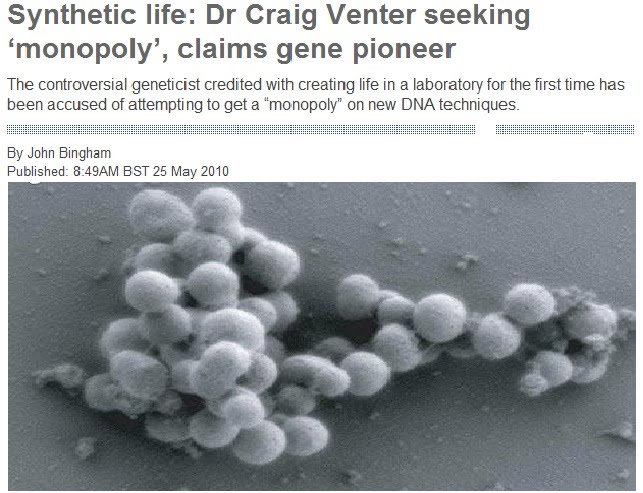 I've been following the reporting on Synthia, the so-called 'synthetic lifeform' or 'synthetic cell'. There's a lot of hype surrounding it, its creators, its promises and its dangers. Its very early days with this science and even earlier days in terms of applying the science ie technological uses - time for us to fully assess what it is and how we best employ it I hope.
Some impressive science is involved but its not really fully 'life made in the lab' because a naturally-occurring microbe, minus its genome, is used as the host and though the genome then inserted is synthetic it needed both yeast and E.coli to be used as part of the production of longer DNA sequences.
 The term 'life' has been applied with little or no reference the fact that there is huge debate about what life is. There is still a challenge for scientists and philosophers to define life in unequivocal terms. Defining life is difficult —in part— because life is a process, not a pure substance. Any definition must be sufficiently broad to encompass all life with which we are familiar, and it should be sufficiently general that, with it, scientists would not miss life that may be fundamentally different from earthly life...(more).
There's been talk of a 'new industrial revolution', bringing together together biology and engineering, using 'synthetic life' to clean up oil pollution and nuclear waste, taking climate changing human carbon emissions from the air, producing biofuels and new vaccines - and even human body parts! Interesting choice of problems caused by industrial revolution(s) that will be 'solved' by purely technical means due to another industrial revolution. Purely technical 'solutions' are all too often no solution at all - remember the technical promise of an 'unsinkable' Titanic, nuclear electricity 'too cheap to meter', freedom of movement via cars tempered by congestion and pollution, nuclear weapons that would deter still ever-present wars.
Technology certainly has a role to play in solving problems - we need it but it should meet the definition of being the practical means to live decently. We should be asking ourselves what proposed technologies are and undertake a rounded assessment of technical capabilities and limitations, cost-effectiveness and impact on working lives and various systems and environments now and on into the future. We need to question technical developments at the earliest possible opportunity as opposed to regarding them as unstoppable drivers of 'progress'. Unconditional surrender to inventions and novelties would mean we had no regard for any possible social, economic and environmental consequences. We need to consider - in a systemic and systematic way - how scientific and technical change can be best harnessed for individual, community, social and environmental good - but we are currently very poor indeed at this task!
Wednesday, May 26, 2010
Thursday, May 20, 2010
Gender equality policy vs practice on Bristol City Council
 …a striptease by burlesque dancer Dita Von Teese…celebrity stripper performed a 10-minute routine…ended with her wearing nipple tassels and a thong at the Bristol Art Gallery and Museum…with her white skin, large breasts and tiny waist, she conforms to the mainstream stereotype of the sexual woman, the dominant cultural image that leaves ordinary women with low self esteem and anxiety, reaching for the cosmetic surgeon’s knife…
The city council has said it “carefully considered the nature of this private launch party” and is “satisfied” that it was appropriate for this event. Julie Finch, director of the council’s museums and archives, and council chief executive Jan Ormondroyd, were both at last night’s event.
http://pocketvenus.wordpress.com/2010/05/15/burlesque-show-upsets-feminists/
_______________________________________________
‘In order to contextualise the promotion of equality between women and men, we plan to deepen and broaden awareness of gender stereotyping and gender equality and develop understanding of the historical basis of discrimination against women.’
‘We will do this by running a seminar series for our employees.’
Bristol City Council, Gender Equality Scheme And Action Plan, 2007 – 2010, page 19
So, should we expect to see several very senior council employees along with senior councillors in Bristol's Cabinet attending a seminar or two on gender stereotyping? Or alternatively will they be abandoning their Gender Equality Scheme and Action Plan?
Labels:
Bristol City Council,
equality,
fair assessment,
feminism,
justice,
liberty,
women
Nuclear power: in a nutshell guide
This is a great film project (http://www.tennerfilms.com/) . Tenner Films is an interactive film and online project which looks at the human stories and the issues surrounding nuclear power. Thirteen short films to entertain and encourage debate have been made (the example above is my favourite so far). Eight have now been completed - check them and the rest of the project out and give the makers some feedback!
You can feedback on-line or by emailing abby@tennerfilms.com. If you would like to hear more about the project as it develops you can also join an email list. You can also join the Facebook group and follow Tenner films on Twitter!
Please pass details of this project to anyone who you think may be interested.
http://www.tennerfilms.com/
More on nuclear power:
http://vowlesthegreen.blogspot.com/2008/01/why-am-i-against-nuclear-power.html
http://vowlesthegreen.blogspot.com/2009/11/new-hinkley-nuclear-plant-likely-to-be.html
http://vowlesthegreen.blogspot.com/2009/03/nuclear-power-too-slow-to-help-solve.html
Labels:
energy,
nuclear power,
nuclear waste,
technology
Wednesday, May 19, 2010
BBC News - Nick Clegg pledges biggest political reforms since 1832
BBC News - Nick Clegg pledges biggest political reforms since 1832
"The biggest shake up of our democracy since 1832, when the Great Reform Act redrew the boundaries of British democracy, for the first time extending the franchise beyond the landed classes." said Clegg
Well, lets hope so because we certainly need change on this scale. However, Nick Clegg does have a very strong tendency to overstate and exaggerate at times, so we shall have to see what happens in practice.
"The biggest shake up of our democracy since 1832, when the Great Reform Act redrew the boundaries of British democracy, for the first time extending the franchise beyond the landed classes." said Clegg
Well, lets hope so because we certainly need change on this scale. However, Nick Clegg does have a very strong tendency to overstate and exaggerate at times, so we shall have to see what happens in practice.
Bristol Eco Veggie Fayre - The UK's Best Veggie Fayre's - the biggest vegan veggie eco friendly family day out in the UK
Bristol Eco Veggie Fayre - The UK's Best Veggie Fayre's - the biggest vegan veggie eco friendly family day out in the UK
Very interesting and well worth a visit - especially given that the brief now includes wider sustainable living issues.
May 29th and 30th 2010
Show opens Saturday May 29th 11am and closes at 11pm
Sunday May 30th 11am - 9pm
Very interesting and well worth a visit - especially given that the brief now includes wider sustainable living issues.
May 29th and 30th 2010
Show opens Saturday May 29th 11am and closes at 11pm
Sunday May 30th 11am - 9pm
Tuesday, May 18, 2010
Elections and coalition government
 I’d just like to put on public record my thanks to the many hundreds of people who supported my views and campaigning for economic wellbeing, social justice and environmental protection by voting for me as the Green candidate for Bristol East in the general election and for Knowle in the local elections. I’m finding the coalition government election outcome a fascinating one to see developing and unfolding. I have mixed feelings about the coalition because whilst I support the principle and practice of cooperation and consensus decision making between all parties it is very clear that the Liberal-Conservative Government is far from progressive and modern: it is planning both huge cuts in public services and large tax rises; the AV voting system we are to have a referendum on is no more fair and proportional than the current system and just tends to reinforce the status quo power of centre-ground politics; the new Cabinet does not fairly reflect our population eg 83% are male and 65% went to either Oxford or Cambridge; it has no more idea on how to reconcile our economy and society with the environment to build a fair, green and sustainable future than the Blair or Brown Governments.
Bristol's Happiness Lectures tonight
Now in its fifth year, The Bristol Happiness Lectures have established a reputation for being enjoyable, interesting events with leading speakers from positive psychology and the science of wellbeing. Initially developed by Chris Johnstone as part of his positive psychology education programme at Bristol University, past contributors have included Oliver James (2008), Ilona Boniwell (2007) and Raj Persaud (2006).
THE BRISTOL HAPPINESS LECTURES 2010 http://www.chrisjohnstone.info/happiness_lectures.htm
This year’s theme: Positive Psychology Responses to Depression natural ways to improve your mood
Tuesday 18th May 2010 7pm - 10pm
With.... Positive Psychologist Miriam Akhtar, (website: http://www.miriamakhtar.co.uk)
GP/Broadcaster Dr Phil Hammond(website: http://drphilhammond.com/)
and Self-help Author Dr Chris Johnstone(website: http://www.chrisjohnstone.info).
At St George’s Hall, Great George Street, Bristol BS1 5RR Price: £10 / £8 concs
THE BRISTOL HAPPINESS LECTURES 2010 http://www.chrisjohnstone.info/happiness_lectures.htm
This year’s theme: Positive Psychology Responses to Depression natural ways to improve your mood
Tuesday 18th May 2010 7pm - 10pm
With.... Positive Psychologist Miriam Akhtar, (website: http://www.miriamakhtar.co.uk)
GP/Broadcaster Dr Phil Hammond(website: http://drphilhammond.com/)
and Self-help Author Dr Chris Johnstone(website: http://www.chrisjohnstone.info).
At St George’s Hall, Great George Street, Bristol BS1 5RR Price: £10 / £8 concs
Thursday, May 13, 2010
Adrian Ramsay :: Deputy Leader :: MP candidate for Norwich South | Lib Dems Have Betrayed Their Voters
Adrian Ramsay :: Deputy Leader :: MP candidate for Norwich South Lib Dems Have Betrayed Their Voters
Adrian Ramsay commented: "There are real risks to cutting back on public spending while the economy is still recovering from recession - which is presumably why the LibDems didn't support making cut backs this year in their manifesto. I'm very concerned that the LibDems have signed up to the Conservative cuts and about what this may mean for crucial local services such as Sure Start nurseries and day care centres.
"The Green Party's General Election manifesto showed that there are ways of dealing with the deficit whilst protecting public services. The way forward should have been through green investment to stabilise the economy, not through public service cuts.
"I fear that the new alliance between the Conservatives and LibDems will take us in the wrong direction. I don't think these cuts are what people in Norwich voted for last week. The Green Party will strongly oppose cuts to crucial services.
"Nick Clegg has also failed to use this situation to secure a fair voting system where every vote counts equally. LibDems have been campaigning for this for decades and this was their chance to make it happen. I think many LibDem activists and voters will be feeling betrayed that Nick Clegg has not made more of this opportunity and will be considering their political home for the future."
Adrian Ramsay commented: "There are real risks to cutting back on public spending while the economy is still recovering from recession - which is presumably why the LibDems didn't support making cut backs this year in their manifesto. I'm very concerned that the LibDems have signed up to the Conservative cuts and about what this may mean for crucial local services such as Sure Start nurseries and day care centres.
"The Green Party's General Election manifesto showed that there are ways of dealing with the deficit whilst protecting public services. The way forward should have been through green investment to stabilise the economy, not through public service cuts.
"I fear that the new alliance between the Conservatives and LibDems will take us in the wrong direction. I don't think these cuts are what people in Norwich voted for last week. The Green Party will strongly oppose cuts to crucial services.
"Nick Clegg has also failed to use this situation to secure a fair voting system where every vote counts equally. LibDems have been campaigning for this for decades and this was their chance to make it happen. I think many LibDem activists and voters will be feeling betrayed that Nick Clegg has not made more of this opportunity and will be considering their political home for the future."
Exhibitions about the regeneration of Knowle West, Inns Court, part of Bedminster and Knowle
Copy of a news release received today: Local residents planning for the future of their area
The Knowle West Residents Planning Group (KWRPG) will be running exhibitions about the regeneration of the wider area, including Knowle West, Inns Court and part of Bedminster and Knowle, at local community centres on Tuesday and Thursday evenings in the last two weeks of May.
KWRPG is a group of local people who are developing a residents’ draft plan for Knowle West, which includes community buildings, shops, facilities, transport, green spaces, schools and more. This plan is NOT set in stone. The group would like other local people to come along to see the ideas they have come up with so far and want to find out what their community thinks about it.
The dates and times are:
1. Eagle House, Newquay Road 18th May, 7-8.30pm
2. Filwood Community Centre, Barnstaple Road 20th May, 7-8.30pm
3. Novers Social Club, Novers Park Road 25th May, 7-8.30pm
4. The Mede Centre (by Inns Court shops) 27th May, 7-8.30pm
5. City of Bristol College, Marksbury Road 3rd June, 7-8.30pm
Alister Palmer, chair of the KWRPG said:
"We are very pleased that Bristol City Council have now made a firm commitment to working with the Residents Planning Group. KWRPG have been meeting every week for 15 months, and meeting with the Project Board and consultants Urban Initiatives at key stages throughout the process. Last month the Project Board and Urban Initiatives came to Knowle West to hear our ideas so far and we await their plan, but in the meantime come and see ours."
"We want all the local people to have their say on what happens with the regeneration in the area, but we realize not everyone can give as much time as the current group members do, so we decided to run the exhibitions. We have timed it so we can feed back local opinion on our ideas to the consultants when they come back in to do more consultation."
For more information about the Knowle West Residents Planning Group and how to get involved call Anita Pearce at Community in Partnership Knowle West 0117 908 4248, or email Iris Eiting at Re:store on Filwood Broadway iris@reworkltd.org.uk
For regular updates or a catch up on what’s happened so far go to www.knowlewest.co.uk and see ‘Regeneration’.
-ends-
Media queries
Anita Pearce, Community in Partnership: 0117 908 4248
Iris Eiting, Re:store: iris@reworkltd.org.uk
The Knowle West Residents Planning Group (KWRPG) will be running exhibitions about the regeneration of the wider area, including Knowle West, Inns Court and part of Bedminster and Knowle, at local community centres on Tuesday and Thursday evenings in the last two weeks of May.
KWRPG is a group of local people who are developing a residents’ draft plan for Knowle West, which includes community buildings, shops, facilities, transport, green spaces, schools and more. This plan is NOT set in stone. The group would like other local people to come along to see the ideas they have come up with so far and want to find out what their community thinks about it.
The dates and times are:
1. Eagle House, Newquay Road 18th May, 7-8.30pm
2. Filwood Community Centre, Barnstaple Road 20th May, 7-8.30pm
3. Novers Social Club, Novers Park Road 25th May, 7-8.30pm
4. The Mede Centre (by Inns Court shops) 27th May, 7-8.30pm
5. City of Bristol College, Marksbury Road 3rd June, 7-8.30pm
Alister Palmer, chair of the KWRPG said:
"We are very pleased that Bristol City Council have now made a firm commitment to working with the Residents Planning Group. KWRPG have been meeting every week for 15 months, and meeting with the Project Board and consultants Urban Initiatives at key stages throughout the process. Last month the Project Board and Urban Initiatives came to Knowle West to hear our ideas so far and we await their plan, but in the meantime come and see ours."
"We want all the local people to have their say on what happens with the regeneration in the area, but we realize not everyone can give as much time as the current group members do, so we decided to run the exhibitions. We have timed it so we can feed back local opinion on our ideas to the consultants when they come back in to do more consultation."
For more information about the Knowle West Residents Planning Group and how to get involved call Anita Pearce at Community in Partnership Knowle West 0117 908 4248, or email Iris Eiting at Re:store on Filwood Broadway iris@reworkltd.org.uk
For regular updates or a catch up on what’s happened so far go to www.knowlewest.co.uk and see ‘Regeneration’.
-ends-
Media queries
Anita Pearce, Community in Partnership: 0117 908 4248
Iris Eiting, Re:store: iris@reworkltd.org.uk
Labels:
democracy,
development,
Knowle,
Knowle West,
local,
people,
planning,
regeneration,
sustainable
Tuesday, May 11, 2010
Councillor Green: Green Councillor!
 As well as winning our first MP in Brighton the Greens also won in Southville, retaining the seat with an increased number of votes and increased majority (click image to enlarge and see the full result). Very well done and many congratulations to Tess Green. Councillor Green - Green Councillor!
Two great wins, one local, one national - both under this ridiculous and unfair first past the post electoral system!
Labels:
being green,
Bristol City Council,
elections,
local,
Southville,
Tess Green
The 'thoroughly unpleasant and really creepy' Nick Griffin
The BNPs Nick Griffin...extra-ordinarily racist, thoroughly unpleasant, really creepy, a nazi, wicked, viscious, misguided, repulsive, a twit.
Labels:
BNP,
fascism,
nationalism,
nazism,
Nick Griffin,
racism
Friday, May 07, 2010
First Green MP elected to the Westminster Parliament!!
Caroline Lucas has been elected MP for Brighton Pavillion - the first Green to be elected to the Westminster Parliament! The full - and historic - result is below:


Labels:
being green,
caroline lucas,
elections,
general election,
leadership,
MPs
Wednesday, May 05, 2010
Bristol East Constituency Results - Vote for Policies - Vote for policies, not personalities!
Constituency Results - Vote for Policies - Vote for policies, not personalities!
22% of people in Bristol East think Green Party policies are best (202 people in the online survey sample).
22% of people in Bristol East think Green Party policies are best (202 people in the online survey sample).
Why vote Green? Part Nine
 Greens work to maximise efficiency, whether energy, water, transport use or other resources. Its why we would insulate all homes free of charge (warming your homes, saving you money, efficiently and rapidly cutting fuel use and carbon emissions, creating thousands of local jobs). Its why we drew up the Home Energy Conservation Act. Its why we want more effective and wide-ranging door-to-door recycling systems. Its why we would cut excessive mileage allowances paid by some councils and Govt departments. Reducing waste makes sense at all sorts of levels: giving value for money; making effective use of resources; reducing pressures on communities and on the environment. Given the results of this online survey http://voteforpolicies.org.uk/, which over a quarter of a million people have completed, the chances are that you agree that the Greens policies are best - we are in first place with over 24% of the vote (click to enlarge image top left for details).
Labels:
climate change,
efficiency,
elections,
general election,
green policies,
waste,
wellbeing,
Why vote Green,
work
Tuesday, May 04, 2010
Making Bristol an even better place: pass on the video
If you could change Bristol what would you change? See the Bristol Greens video on making Bristol an even better place below - and pass on details to your friends and family http://tinyurl.com/betterbristol .
Tackling the triple crises: recession; climate change; rising inequality
 Tackling climate change has long been a key campaigning issue for the Green Party. I have received tens of emails on it during this election campaign (see below). I've been working on this issue, both politically and through my employment, since 1982/3! I will be debating this and other related matters with other candidates at the hustings organised by Greenpeace tonight at the City Academy, Russell Town Avenue, 7.30pm.
My party is committed to a set of economic, social and environmental policies designed to cut carbon emissions by 10% per year (eg insulating all homes free of charge, massive investment in public transport and renewable energy...). We have a £44 billion investment package - the Green New Deal - designed to tackle the triple crises: recession; climate change; rising inequality. I have been working to illustrate the quality of life, wellbeing and food, job and energy security benefits of green policies that tackle climate change for many years. http://www.onlygreen.org.uk/
I will continue to work, as I have for decades before this election, for the establishment of a fair and sustainable society ie one that has health and wellbeing as the measure of progress in place of ‘growth’ and which reconciles the economic and social with our environment such that we can
all lead decent lives now and on into the future.
____________________________________________________
>Dear Mr Vowles,
>
>I live in your constituency, and I am writing to let you know that my
>vote will be strongly influenced by which candidates speak up publicly on
>climate change.
>
>MPs elected at this general election will have the responsibility to
>drive the low carbon economic recovery that Britain needs. With proper
>political leadership, Britain can upgrade its outdated energy and
>transport infrastructure and housing stock, keep consumer bills down and
>create tens of thousands of sustainable jobs.
>
>So, I plan to vote for action on climate change, so that I get an MP who
>will champion the opportunities presented by a transformation to a low
>carbon economy.
>
>As a supporter of Greenpeace, I'm aware that tens of thousands of people,
>many of whom are supporters of RSPB, WWF, Oxfam and Christian Aid and
>other organisations, want to see candidates show commitment to action on
>climate change during their election campaign. As a result I will be
>paying close attention to which candidates speak up on this issue.
>
>Every constituency can benefit from action on climate change, and can
>achieve energy efficient homes and businesses, a growth in jobs and
>skills and a more competitive local economy. Many constituencies can
>benefit from the growing offshore wind power industry as competition
>mounts to secure long term supply chain jobs in different parts of the
>country.
>
>All the major political party leaders have said they support action on
>climate change and a more efficient low carbon economy. Do you plan to
>outline how you aim reap the benefits of a low carbon recovery this
>constituency? Will you make a public statement about your commitment to
>tackling climate change?
>
>Please let me know how you plan to ensure that at least 15% of all energy
>comes from renewable sources by 2020, and how you will ensure that our
>constituency benefits from a transition to a low carbon economy.
>
>Yours sincerely,
>
>I live in your constituency, and I am writing to let you know that my
>vote will be strongly influenced by which candidates speak up publicly on
>climate change.
>
>MPs elected at this general election will have the responsibility to
>drive the low carbon economic recovery that Britain needs. With proper
>political leadership, Britain can upgrade its outdated energy and
>transport infrastructure and housing stock, keep consumer bills down and
>create tens of thousands of sustainable jobs.
>
>So, I plan to vote for action on climate change, so that I get an MP who
>will champion the opportunities presented by a transformation to a low
>carbon economy.
>
>As a supporter of Greenpeace, I'm aware that tens of thousands of people,
>many of whom are supporters of RSPB, WWF, Oxfam and Christian Aid and
>other organisations, want to see candidates show commitment to action on
>climate change during their election campaign. As a result I will be
>paying close attention to which candidates speak up on this issue.
>
>Every constituency can benefit from action on climate change, and can
>achieve energy efficient homes and businesses, a growth in jobs and
>skills and a more competitive local economy. Many constituencies can
>benefit from the growing offshore wind power industry as competition
>mounts to secure long term supply chain jobs in different parts of the
>country.
>
>All the major political party leaders have said they support action on
>climate change and a more efficient low carbon economy. Do you plan to
>outline how you aim reap the benefits of a low carbon recovery this
>constituency? Will you make a public statement about your commitment to
>tackling climate change?
>
>Please let me know how you plan to ensure that at least 15% of all energy
>comes from renewable sources by 2020, and how you will ensure that our
>constituency benefits from a transition to a low carbon economy.
>
>Yours sincerely,
Friday, April 30, 2010
What has it got to do with me?
Up early, far too early it now feels, in order to be interviewed live on Radio Bristol this morning (click here and scroll to about 1 hour 40 mins to listen to my 5 minutes). Was out until late(ish) watching and listening to a Benjamin Zephaniah and Francesca Beard poetry performance at the Arnolfini last night, then watched a recording of the 'leaders debate' when I got home. Suffice to say that there was a great deal more of political value in the poetry performances than in the 'leaders debate'! See the very striking What has it got to do with me (above), Rong Radio and of course Talking Turkeys (links below) .
http://www.youtube.com/watch?v=a3HjMcY50Kc
http://www.youtube.com/watch?v=v4AgPSjzXkw&feature=related
Labels:
Bristol East,
elections,
general election,
information,
leaders tv debates,
leadership,
news,
poetry
Stockwood Pete: Clear Green Water
Stockwood Pete: Clear Green Water
Three very distinctive reasons to vote Green in the local elections from Peter Goodwin the excellent Green Candidate for Stockwood (Pete gained 20% of the Stockwood vote and second place in the 2007 elections). See my series of 'Why vote Green' posts for further information (click on the Why Vote Green label on the right hand side or just search my blog using these words).
Three very distinctive reasons to vote Green in the local elections from Peter Goodwin the excellent Green Candidate for Stockwood (Pete gained 20% of the Stockwood vote and second place in the 2007 elections). See my series of 'Why vote Green' posts for further information (click on the Why Vote Green label on the right hand side or just search my blog using these words).
BBC News - Police probe Twitter votes gaffe by Bristol candidate
BBC News - Police probe Twitter votes gaffe by Bristol candidate
Bristol East surely deserves an MP who thinks before they act, who has a decent understanding of electoral law - and in fact a bit of good sense and responsibility about what is fair play to other candidates and to voters during an election??
A Labour candidate has apologised for revealing a sample of postal votes on the social networking website Twitter.
Bristol East candidate and party 'Twitter tsar' Kerry McCarthy said she was "kicking herself" after the gaffe.
Avon and Somerset Constabulary said it was looking into a possible alleged breach of electoral law.
It is illegal to reveal the votes cast before the end of polling day because it may influence the outcome of the election.
A Bristol City Council spokesman said the authority had reported the matter to the police after Ms McCarthy brought it to their attention.
Bristol East surely deserves an MP who thinks before they act, who has a decent understanding of electoral law - and in fact a bit of good sense and responsibility about what is fair play to other candidates and to voters during an election??
A Labour candidate has apologised for revealing a sample of postal votes on the social networking website Twitter.
Bristol East candidate and party 'Twitter tsar' Kerry McCarthy said she was "kicking herself" after the gaffe.
Avon and Somerset Constabulary said it was looking into a possible alleged breach of electoral law.
It is illegal to reveal the votes cast before the end of polling day because it may influence the outcome of the election.
A Bristol City Council spokesman said the authority had reported the matter to the police after Ms McCarthy brought it to their attention.
Thursday, April 29, 2010
Bristol East hustings
 Bristol East hustings to come - all welcome to attend and put searching questions!!
1. This Friday 30th April, St John's Church, Lodge Causeway, 7.30pm. Organised by local churches and likely to cover all issues. Most candidates (including the invisible Tory Adeela Shafi) have been invited though I dont have a confirmed list.
2. Next Tuesday, 4th May, 7pm for 7.30pm debate at the City Academy, Russell Town Avenue. Organised by Greenpeace, so likely to focus in on issues like climate change, Trident nuclear weapons and so on. Labour, Tories, Libs and Greens will be present (not heard that TUSC or others will be there).
Labels:
Adeela Shafi,
Bristol East,
elections,
general election,
information,
Kerry McCarthy,
local,
news
Working for human rights here and around the globe
 I'm grateful to the many people who have contacted me on the important issue of human rights (see example below). I very strongly agree with them about the importance of human rights and feel that MPs and Govts should see that: human rights are not undermined by a security agenda that denies opportunity for a fair trial or seeks to deport foreign nationals to countries where they face a serious risk of torture; the human rights framework in the UK is protected; leadership is shown in addressing the preventable deaths of women and children; the ‘Manifesto for Motherhood’ is supported; the debate on asylum and immigration is a principled one that does not pander to the prejudices of those with extreme views on this issue. If elected I would work very hard in all these areas. I signed up to support the Manifesto for Motherhood a while back now. I hope human rights activists agree with me that the Green Movement is at the forefront of many struggles for human rights around the globe eg for land, peace, basic needs, fundamental rights and more. http://www.onlygreen.org.uk/
__________________________________________________
Dear Mr Vowles,
I am writing as a supporter of Amnesty International in your constituency to ask what you can do to promote and protect human rights if you are elected to Parliament.
I know that you will be receiving information from many individuals and organisations asking you to support their policy recommendations to the next government.
However, I hope that you will agree that respect for human rights should be at the centre of all government policies, and therefore ask you, if elected, to ensure that:
- Women’s human rights are respected in the UK and overseas, including freedom from violence and active participation in decisions affecting their lives.
- Human rights are not undermined by a security agenda that denies opportunity for a fair trial or seeks to deport foreign nationals to countries where they face a serious risk of torture.
- The human rights framework in the UK is protected
- Leadership is shown in addressing the preventable deaths of women and children and to give your support to the ‘Manifesto for Motherhood’.
- The debate on asylum and immigration is a principled one that does not pander to the prejudices of those with extreme views on this issue.
I hope that you will support these recommendations and maintain a commitment to human rights during your election campaign and after.
Many thanks for your attention in this matter; I look forward to your reply.
Yours sincerely,
Labels:
Bristol East,
democracy,
elections,
equality,
general election,
justice,
law,
liberty
Freedom and space to play for children
 I’m a longstanding and very active campaigner for the protection and enhancement - and indeed increase in – green, open and natural spaces in Bristol. I’ve also worked hard for safer residential streets with a 20mph speed limit. I'm naturally very strongly committed to Play England's Manifesto for childrens play, so that children and young people have the same freedom and space to play enjoyed by previous generations. I’ve signed up to:
1. To make all residential neighbourhoods child-friendly places where children can play outside 2. To give all children the time and opportunity to play throughout childhood 3. To give all children somewhere to play – in freedom and safety – after school and in the holidays. This is a vital aspect of a society where health and wellbeing are the true measure of progress.
http://vowlesthegreen.blogspot.com/search/label/green%20spaces
http://vowlesthegreen.blogspot.com/search/label/20mph
Labels:
20mph,
Bristol East,
elections,
general election,
green spaces,
health,
open spaces,
play,
quality of life,
sport,
wellbeing,
young people
Wednesday, April 28, 2010
Meet my reasonable needs to do the job of MP - no more, no less
 Spoke at a very interesting meeting organised by the Public and Commercial Services Union (PCS) last night in Whitehall. I'm grateful to the meeting organisers and to all those who attended and asked a wide range of searching questions. I'm already on record as supporting PCS campaigning to protect and promote public services, jobs, equality, those on low pay and unfair conditions of employment, and to fight fascism (see here and here). What I said went down well I think. There was good agreement in many respects between myself and TUSC candidate Rae Lynch (http://www.tusc.org.uk/) - not that this post constitutes a total endorsement of course!!
One of the most striking questions was on MPs pay and expenses. It was very powerfully put and reminded me of the commitment given now and whilst he was a Labour MP by socialist Dave Nellist to take 'only the wage of a skilled factory worker (40% of what he could have earned), less than half that which other MPs took for themselves, the rest he donated back to the Labour movement and to charities'. It also reminded me of the commitment I made on the issue of MPs pay and expenses all the way back in July 2008 (before the MPs expenses scandal) here (relevant extract below*). I am personally committed to making no net financial gain in any way, shape or form from being an MP and have always believed that only my needs to do the job of MP and should be met, no more and no less. I also believe very strongly in the merits of MPs living on income similar to that of people in general.
_________________________________________________
*Extract from July 2008 post: I recently posted about the work of the Joseph Rowntree Foundation who looked at what various categories of people need in order to live at an acceptable standard and participate in UK society. I propose that this sort of method should be applied to all MPs, including members of the Government - get a fair, independent body to examine what is needed for MPs to do their jobs well and also live decent, reasonably rounded lives and pay them and/or provide them with appropriate facilities as required.If I was ever elected as an MP (I wish!!) I would certainly work on this basis, whether or not this kind of system was the official one. Are any local MPs willing to have an independent body go over what their actual needs are?
Labels:
being green,
Bristol East,
elections,
excess,
fascism,
general election,
MPs,
needs,
service,
unethical politics,
work
Tuesday, April 27, 2010
Free eye tests for all
 Copy of RNIB media release: Glenn Vowles Green Candidate for Bristol East takes RNIB quiz and says “It’s time we all took more care of our eyes ….that's why Greens would reintroduce free eye tests for all”
Glenn Vowles today took part in a quiz from RNIB to raise awareness amongst election candidates of the leading causes of sight loss. Questions also ask who can get free eye tests and how many of us are already living with sight problems.
Six million older people at risk of blindness
There are around 1.8 million people in the UK already living with sight loss, with around 2700 in Bristol East. RNIB’s quiz revealed that pensioners are most at risk of losing their sight, in fact two-thirds of partially sighted people are aged 75 or over. Yet, six million older people in the UK (47 per cent) are needlessly risking their sight by not having their eyes tested regularly, despite being eligible for free eye tests.
Saving sight
Mr Vowles was also shocked to learn that nearly 50 per cent of all sight loss is avoidable. This includes people with refractive error – that is people in need of a correct prescription for glasses or contact lenses - and people who have lost sight through conditions that could have been treated if detected early enough, such as glaucoma.
Glenn said, "Sight is the sense we most fear losing, so why are so many of us are potentially putting it at risk through not having regular sight tests? There needs to be a greater public understanding that a sight test isn't just about whether you need glasses, it can also detect signs of eye disease. It’s time we all took eye health and sight loss seriously."
RNIB recommends that everyone should get their eyes tested every two years, or more frequently if recommended by an optometrist.
-ends-
Notes to editors
1. Glenn Vowles, tel 0117 9717023, glennvowles@bristolgreenparty.org.uk
2. Royal National Institute of Blind People (RNIB) is the UK's leading charity offering information, support and advice to around two million people with sight loss. Visit www.rnib.org.uk or call 0303 123 9999.
3. The production of the quiz has been supported a by third-party agency provided by Novartis Pharmaceuticals UK Ltd.
RNIB is non-political in its dealings and during the general election campaign and adheres to Charity Commission Guidance. RNIB does not support the views of any particular party.
Labels:
Bristol East,
elections,
general election,
health,
quality of life,
wellbeing
The Small Charities Coalition
 Passing this message on...The Small Charities Coalition helps small charities...With over 160,000 charities registered in England and Wales and 139,915 having incomes of less than £500k* there are bound to be dozens or even hundreds of small charities within your constituency who could benefit (*Source: Charity Commission, Dec 2009).
The Small Charities Coalition helps small charities get access to the advice and guidance they need - sometimes even training - free of charge, and without cooking the books!
A small charity is matched with an individual supporter that has the skills to mentor or coach the charity through a specific problem or a longer term issue such as organisational development or generating sustainable income. This supporter will either come from a fellow small charity or larger organisation. Small charities and supporters can also tap into the Coalition’s ever growing network at events and keep up to date with regular emails and newsletters. All that we ask in return is that charities be prepared to share their own skills and experience with their fellow small charities.
The Small Charities Coalition operates nationally and currently has 450 small charity members and 100 Supporters from charities such as Cancer Research UK, Beatbullying, Oxfam, British Red Cross and Anthony Nolan Trust. The more organisations that join, the more diverse and rich resources we have to draw on to help small charities.
So help us to help small charities in your constituency by telling them about the Small Charities Coalition and by displaying our poster (see image, click to enlarge) wherever you can. For more information please contact me on 020 7391 4812 or email atinfo@smallcharities.org.uk .
Thank you
Cath Lee
Chief ExecutiveSmall Charities Coalition
http://www.smallcharities.org.uk/
Thank you
Cath Lee
Chief ExecutiveSmall Charities Coalition
http://www.smallcharities.org.uk/
Tel 0207 391 4812
Monday, April 26, 2010
For animal wellbeing, opposing animal cruelty and suffering
 Completed Policy Questionnaire for Candidates in the 2010 General Election www.vote4animals.org.uk
Dear Candidate,
Please provide your name, party and the constituency you are contesting, delete ‘YES’ or ‘NO’ as appropriate, sign and date the questionnaire at the end, and return copies of completed questionnaire as soon as possible to (1) your constituent and (2) to PAD, 5th Floor, Alliance House, 9 Leopold Street, Sheffield S1 2GY; email research@vote4animals.org.uk ; fax 0114 2722225.
Candidate’s Name, Party & Constituency: Glenn Vowles, Green Party, Bristol East
1. Hunting Ban
Recent opinion polling confirms a clear majority of both rural and urban dwellers are opposed to hunting with hounds. The legitimate sphere of personal freedom does not extend to cruelty and violence towards others.
Will you support the Hunting Act 2004, oppose any moves to repeal this legislation, and support robust enforcement of the Act?
YES
2. Democratic Reform
The Animal Welfare Act does not cover animals used in agriculture and research. A situation has evolved over many decades whereby the Government takes decisions affecting millions of animals in closed policy processes dominated by commercial interests, with animal welfare considerations effectively excluded. The ethical concerns of the public are largely ignored, undermining democracy and public trust in politics. We need a democratically-accountable body to create a level playing field and ensure animal protection is given a meaningful voice in Government for the first time.
2. Democratic Reform
The Animal Welfare Act does not cover animals used in agriculture and research. A situation has evolved over many decades whereby the Government takes decisions affecting millions of animals in closed policy processes dominated by commercial interests, with animal welfare considerations effectively excluded. The ethical concerns of the public are largely ignored, undermining democracy and public trust in politics. We need a democratically-accountable body to create a level playing field and ensure animal protection is given a meaningful voice in Government for the first time.
Will you support the establishment of an Animal Protection Commission with overall responsibility for all policies affecting animal wellbeing?
YES
3. Battery Egg Farming
Battery farming of eggs – involving around 30 million hens every year - is arguably the cruellest form of farming in the UK. Current EU plans to replace conventional battery cage with so-called ‘enriched’ battery cages by 2012 are inadequate. ‘Enriched’ battery cages share many of the serious welfare problems common to the conventional battery cage. A comprehensive ban on battery cages will complement the scheduled 2011 prohibition of de-beaking, which is a painful and unnecessary mutilation.
Do you support a full ban on all battery cages for egg laying hens in 2012 and the scheduled prohibition of de-beaking in 2011?
4. Reducing and Eliminating Animal Experimentation
There is broad agreement that the infliction of pain on animals raises serious ethical concerns and that there are significant scientific limitations to the use of animal models as a guide to human biology. We therefore support the recommendation of the Home Office’s Animal Procedures Committee for a determined, targetted effort to bring about the end of animal use. In other policy areas, demanding targets have been identified as providing a goal even where these targets might require technological and other innovation if they were to be met. We believe in an analogous strategy in relation to animal use.
Do you support a strategy to identify and implement targets for the reduction and elimination of animal experimentation?
YES
5. Animal Experiments: Freedom of Information
Section 24 of the Animals (Scientific Procedures) Act 1986 blocks the publication of important information about animal experiments. PAD and the other major animal protection groups agree that researchers' names and addresses and genuinely confidential information should remain secret. Given that each animal experiment is only rendered legal through the authorisation by the Government, acting on behalf of voters, we believe that the public should be able to access all other information relevant to the ethics of animal experiments, including what is being done to the animals and for what purpose.
Do you support the repeal of Section 24 of the 1986 Act and the application of FOI to animal experiments, except for personal and genuinely confidential information?
6. Biofuels and Animal Habitats
The preservation of natural habitats is crucial to protect the welfare of individual animals as well preserving biodiversity and other environmental benefits. Increasing demand for biofuels has proved to be a leading driver of deforestation in some of the most biodiverse places on earth, causing widespread suffering and death to many animals. Government incentives supporting the use of palm and other vegetable oils as fuel for transport, power generation and heating in the EU, are driving animals such as orangutans to the brink of extinction. Furthermore, the alternative source of biofuels is growing crops on agricultural land, which directly competes with growing food for people in areas where food scarcity is already a problem. Biofuels are not a sustainable solution to climate change, unlike truly renewable energy from sources such as wind, solar and tidal.
Do you support only giving subsidies to sustainable forms of energy production that protect animal welfare, and ensuring that biofuels with the exception of those sourced from true waste products (e.g. biogas from sewage) are not supported through targets and incentives?
YES
Labels:
animals,
biodiversity,
Bristol East,
elections,
environment,
general election,
justice,
law,
nature,
wellbeing
Doubt, questioning, evidence, reason...progress
 As someone who very strongly believes in questioning, doubt, scepticism, naturalism and reasoning I was very interested to receive the email below* from the British Humanist Association (http://www.humanism.org.uk/home). I responded to the 'doorstep questions' in their manifesto as follows:
DOORSTEP QUESTIONS
1. Should government departments treat humanist, secular and religious organisations equally in policy making, funding decisions and consultations?
Yes
2. Should religious organisations be contracted to deliver public services?
1. Should government departments treat humanist, secular and religious organisations equally in policy making, funding decisions and consultations?
Yes
2. Should religious organisations be contracted to deliver public services?
No
3. What do you think the government's policy should be on faith schools?
No publicly-funded school should be run by a religious organisation. Schools should teach about religions, comparing examples which originated in each continent, but should not deliver religious instruction in any form or encourage adherence to any particular religious belief.
Privately-funded schools run by religious organisations should reflect the inclusive nature of British society and become part of the Local authority admissions system. This non-discriminatory approach should be extended to staff who must not be discriminated against in faith schools due to their own faith either in seeking employment or during employment.
4. What do you think about exemptions for religious organisations from aspects of antidiscrimination and equality legislation?
There should be no religious exemptions from equality and anti-discrimination legislation
5. Would you vote to retain or remove bishops from the House of Lords?
Remove!!
6. How would you vote on abortion / assisted dying for the terminally ill?
In favour of both
7. Will you defend the Human Rights Act?
Yes
8. Do you think dialogue work that doesn't include non-religious people (e.g. 'interfaith' work) is desirable?
No - dialogue should include non-religious people.
9. Do you think that religious leaders should have privileged access to policy and decision makers?
No!!
10. Do you think that publicly funded faith schools should be allowed to discriminate in their admissions and employment?
3. What do you think the government's policy should be on faith schools?
No publicly-funded school should be run by a religious organisation. Schools should teach about religions, comparing examples which originated in each continent, but should not deliver religious instruction in any form or encourage adherence to any particular religious belief.
Privately-funded schools run by religious organisations should reflect the inclusive nature of British society and become part of the Local authority admissions system. This non-discriminatory approach should be extended to staff who must not be discriminated against in faith schools due to their own faith either in seeking employment or during employment.
4. What do you think about exemptions for religious organisations from aspects of antidiscrimination and equality legislation?
There should be no religious exemptions from equality and anti-discrimination legislation
5. Would you vote to retain or remove bishops from the House of Lords?
Remove!!
6. How would you vote on abortion / assisted dying for the terminally ill?
In favour of both
7. Will you defend the Human Rights Act?
Yes
8. Do you think dialogue work that doesn't include non-religious people (e.g. 'interfaith' work) is desirable?
No - dialogue should include non-religious people.
9. Do you think that religious leaders should have privileged access to policy and decision makers?
No!!
10. Do you think that publicly funded faith schools should be allowed to discriminate in their admissions and employment?
No
________________________________________________
*I am delighted to enclose the British Humanist Association’s (BHA) General Election Manifesto. The BHA is the national charity representing the interests of the large and growing population of ethically concerned non-religious people living in the UK. It exists to support and represent people who seek to live good and responsible lives without religious or superstitious beliefs.
The numbers of such people are undoubtedly growing and current figures (from the British Social Attitudes survey of January 2010) suggest that 43% of the population is happy to self-identify as non-religious, with the numbers of those not practising or affiliated to a religion much higher.
The BHA is deeply committed to human rights, equality, democracy, and an end to irrelevant discrimination, and has a long history of active engagement in work for an open and inclusive society. In such a society, people of all beliefs would have equal treatment before the law, and the rights of those with all beliefs to hold and live by them would be reasonably accommodated within a legal framework setting minimum common legal standards.
The Manifesto set out the BHA’s vision on a number of core areas of work, from human rights to faith schools to free speech. These are all important issues for the millions of non-religious people in the UK.
We have included a number of questions in the Manifesto for your consideration and we would appreciate it if you could take a few moments to consider the questions and email us your answers to pepper@humanism.org.uk. We will use collate the answers for information and may pass them on to another organisation who is mapping the views of PPC’s on various issues.
Yours sincerely,
Andrew Copson
Chief Executive
BHA
Labels:
abortion,
assisted dying,
Bristol East,
democracy,
education,
elections,
equality,
fair assessment,
faith,
general election,
justice,
nature,
people,
reason,
religion,
scepticism,
science,
service
Support for nurses, patients and the NHS
 Nurses and members of the public from every part of the UK have come together behind the RCN's six priorities for UK health...As a candidate for Parliament I have signed the priorities listed below and showed my support for nurses, patients, and the NHS. Voters can support nurses by emailing their candidates seeking their views and asking them to sign up as I have (click here to do this).
*Standing up for staff who speak out
*Safer staffing levels
*Give nurses the time to train
*Protect the nation's health
*Improve care for those with long term conditions
*Sustain healthcare investment
Labels:
Bristol East,
elections,
general election,
health,
nursing,
quality of life,
wellbeing
Green commitment to public services
 Just signed up to all statements in the Public and Commercial Services Union (PCS) pledge and will be speaking on how Green policies are consistent with them at a candidates question time meeting organised by PCS tomorrow night, 6pm, at The Rose Green Centre, Gordon Rd, Whitehall (had several of the emails below*). I have pledged to: work to ensure that public services are properly resourced and delivered by the public sector and that there are no further local office closures, public sector job cuts or privatisations; support measures aimed at closing the UK tax gap including recruiting HMRC staff and ensuring tax loopholes are closed; support civil service national pay bargaining and to press the government to offer pay increases to public sector workers at least in line with inflation; honour the 2005 commitment on public sector pensions and defend the rights of existing members of the civil service compensation scheme; campaign to ensure any changes to public services are only made after proper equality impact assessments have been conducted and their findings implemented. I've previously expressed my strong support for the campaigns of the PCS on pay, jobs, office closures, privatisation, tax staff and fighting fascism here.
Greens are committed to high investment in public services and to opposing cuts. We have a £44 billion Green New Deal investment plan designed to begin the creation of a fair and sustainable society ie one that has health and wellbeing as the measure of progress in place of ‘growth’ and
which reconciles the economic and social with our environment such that we can all lead decent lives now and on into the future. Greens are arguing very strongly for: redistribution of wealth; closing the equality gap; resource efficiency; renewability; staying within environmental limits;
strong and empowered local communities; quality of life (see the Greens policies/manifesto at: http://www.onlygreen.org.uk/ )
______________________________________________________
*Dear Mr Vowles,
>
>I am writing to you as a prospective constituent to let you know about my
>union’s election campaign, Make Your Vote Count and to ask you to respond
>to our five election pledges.
>
>My union, the Public and Commercial Services Union, represents almost
>300,000 members in the civil service, non departmental public bodies and
>the private sector right across the country.
>
>As you know, public services are a particularly pertinent issue in this
>election and I am keen to find out where you stand on our key campaign
>issues (see below). Once you have responded to our election pledges this
>information will be distributed to PCS members locally and also published
>on the PCS website.
>
>1) I pledge to work to ensure that public services are properly resourced
>and delivered by the public sector and that there are no further local
>office closures, public sector job cuts or privatisations.
>2) I pledge to support measures aimed at closing the UK tax gap including
>recruiting HMRC staff and ensuring tax loopholes are closed.
>3) I pledge to support civil service national pay bargaining and to press
>the government to offer pay increases to public sector works at least in
>line with inflation.
>4) I pledge to honour the 2005 commitment on public sector pensions and
>defend the rights of existing members of the civil service compensation
>scheme.
>5) I pledge to campaign to ensure any changes to public services are only
>made after proper equality impact assessments have been conducted and
>their findings implemented.
>
>I would therefore be very grateful if you could outline your position on
>each of our pledges above in 150 words or less and send your response to
>.....or myvc@pcs.org.uk by 26 April.
>
>This offers you a unique opportunity to demonstrate your commitment to
>public services to me and other PCS members in your constituency. If you
>have any questions about this request or would like further information
>on our campaigns please visit www.pcs.org.uk/myvc .
>
>Yours sincerely
>
>I am writing to you as a prospective constituent to let you know about my
>union’s election campaign, Make Your Vote Count and to ask you to respond
>to our five election pledges.
>
>My union, the Public and Commercial Services Union, represents almost
>300,000 members in the civil service, non departmental public bodies and
>the private sector right across the country.
>
>As you know, public services are a particularly pertinent issue in this
>election and I am keen to find out where you stand on our key campaign
>issues (see below). Once you have responded to our election pledges this
>information will be distributed to PCS members locally and also published
>on the PCS website.
>
>1) I pledge to work to ensure that public services are properly resourced
>and delivered by the public sector and that there are no further local
>office closures, public sector job cuts or privatisations.
>2) I pledge to support measures aimed at closing the UK tax gap including
>recruiting HMRC staff and ensuring tax loopholes are closed.
>3) I pledge to support civil service national pay bargaining and to press
>the government to offer pay increases to public sector works at least in
>line with inflation.
>4) I pledge to honour the 2005 commitment on public sector pensions and
>defend the rights of existing members of the civil service compensation
>scheme.
>5) I pledge to campaign to ensure any changes to public services are only
>made after proper equality impact assessments have been conducted and
>their findings implemented.
>
>I would therefore be very grateful if you could outline your position on
>each of our pledges above in 150 words or less and send your response to
>.....or myvc@pcs.org.uk by 26 April.
>
>This offers you a unique opportunity to demonstrate your commitment to
>public services to me and other PCS members in your constituency. If you
>have any questions about this request or would like further information
>on our campaigns please visit www.pcs.org.uk/myvc .
>
>Yours sincerely
Labels:
Bristol East,
education,
elderly,
elections,
equality,
fair assessment,
general election,
health,
justice,
service,
women,
work,
young people
Subscribe to:
Comments (Atom)